Weapons
Irradiation Testing for Weapon Surfaces and Housing Components
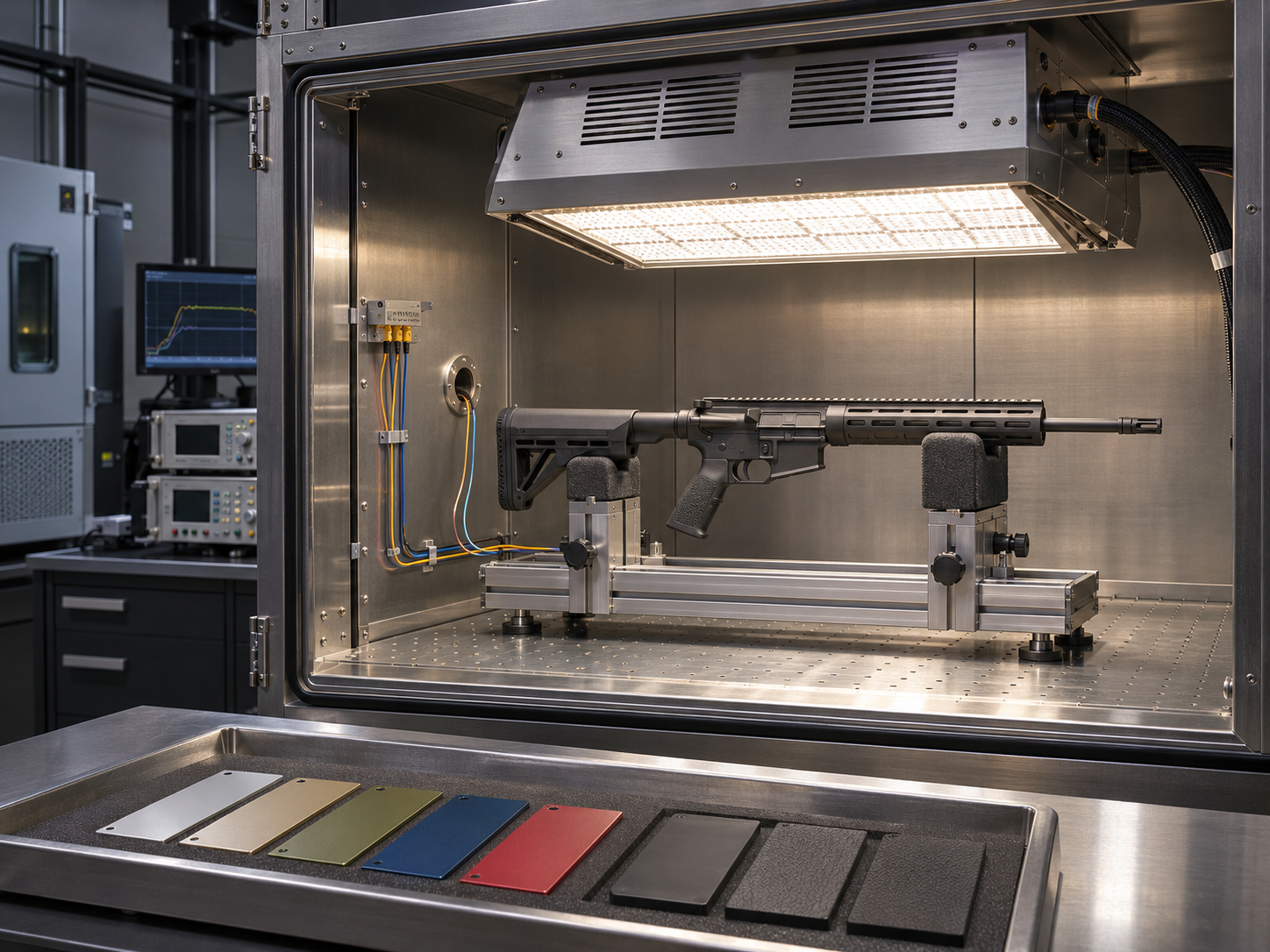
External components and surfaces of weapon systems are exposed to different environmental influences during storage, transport and preparation for use. Material evaluation may therefore consider both heating under solar radiation and changes following prolonged light exposure.
Defined irradiation tests make it possible to compare coatings, plastic parts and other external components under specified conditions. Depending on the investigation, individual material samples or representative assemblies are examined.
BF Engineering develops irradiation equipment for these environmental and material tests. The radiation source, specimen mounting and measurement concept are tailored to the agreed test objective.
Evaluate environmentally induced material changes
The investigation begins by defining which material properties are to be examined. The focus may be on appearance, surface condition or the temperature development of an external component.
Comparative tests allow different material and coating variants to be subjected to the same exposure. Initial condition, specimen preparation and exposure conditions are documented so that differences can subsequently be evaluated in a traceable way.
Typical areas of investigation:
- Heating of external housing and panel surfaces
- Colour and gloss changes in coatings
- Material changes in plastic components
- Condition of covers and flexible protective parts
- Comparison of different material and surface configurations
Consider material, pretreatment and coating together
A surface often consists of a combination of base material, pretreatment and coating. The complete construction under investigation is therefore described to support meaningful comparisons.
Manufacturing and conditioning conditions can also be relevant to evaluation. Layer thickness, curing and storage before testing are recorded according to the investigation objective. Small test panels can facilitate comparisons between variants, while component specimens additionally account for geometry.
Important specimen information:
- Base material and surface pretreatment
- Type and structure of existing coatings
- Layer thickness and curing conditions
- Material composition of plastic parts
- Initial condition and clear specimen identification
Reproduce thermal and light-related conditions appropriately
An investigation into heating has different requirements from targeted UV exposure. The irradiation concept is therefore derived from the test objective and intended procedure.
Alongside the spectrum, intensity, spatial distribution and exposure duration are defined. If additional environmental influences are to be included, these are considered within the overall test programme. Irradiation direction and specimen mounting remain documented during comparative tests.
Relevant exposure parameters:
- Radiation spectrum suited to the test objective
- Irradiance at the specimen surface
- Surface and ambient temperatures
- Exposure duration and radiant exposure
- Orientation, shading and any additional climatic conditions
Record changes in defined characteristics
Evaluation is based on documented initial measurements and agreed assessment criteria. The relevant characteristics are examined again after specified exposure stages.
Depending on the task, visual assessments, optical measurements or supplementary material tests may be used. The irradiation system provides the exposure; selecting the subsequent analytical methods forms part of the overall test concept.
Possible evaluation parameters:
- Colour and gloss
- Cracks and changes in surface structure
- Condition of coatings and material composites
- Mechanical properties of suitable material samples
- Temperature profiles during heating and cooling
Design specimen mounting and measurement access appropriately
Material samples and assemblies require different mounting arrangements. The holder is planned so that the intended surface receives defined irradiation and the required measurement points remain accessible.
BF Engineering tailors the irradiation equipment to the existing test infrastructure. Supply requirements, heat release, operation and interfaces with supplementary systems are considered.
Relevant integration considerations:
- Specimen dimensions and mounting
- Defined orientation of the surfaces under investigation
- Access for temperature and radiation measurements
- Monitoring and documentation of operating conditions
- Maintenance access and recurring verification measurements
Any questions?
We're happy to help.
BF is a forward-looking company that specializes in the development, manufacture, and optimization of high-precision systems and specialized irradiation equipment for test benches.

Your contact person
Danelis Diaz
Management Backoffice

Never miss a thing
BF is a forward-looking company that specializes in the development, manufacture, and optimization of high-precision lighting systems and specialized illumination systems for test benches.