Wood
Irradiation Testing for Wood and Wood Surfaces
Wood surfaces change under the influence of light and weathering. Several factors interact: solar radiation, moisture and temperature affect the appearance and condition of the surface. Evaluation must therefore suit the intended indoor or outdoor application.
Defined laboratory experiments make it possible to compare wood species, surface treatments and coating systems under comparable conditions. Natural differences between specimens are considered alongside the selected radiation source and experimental sequence.
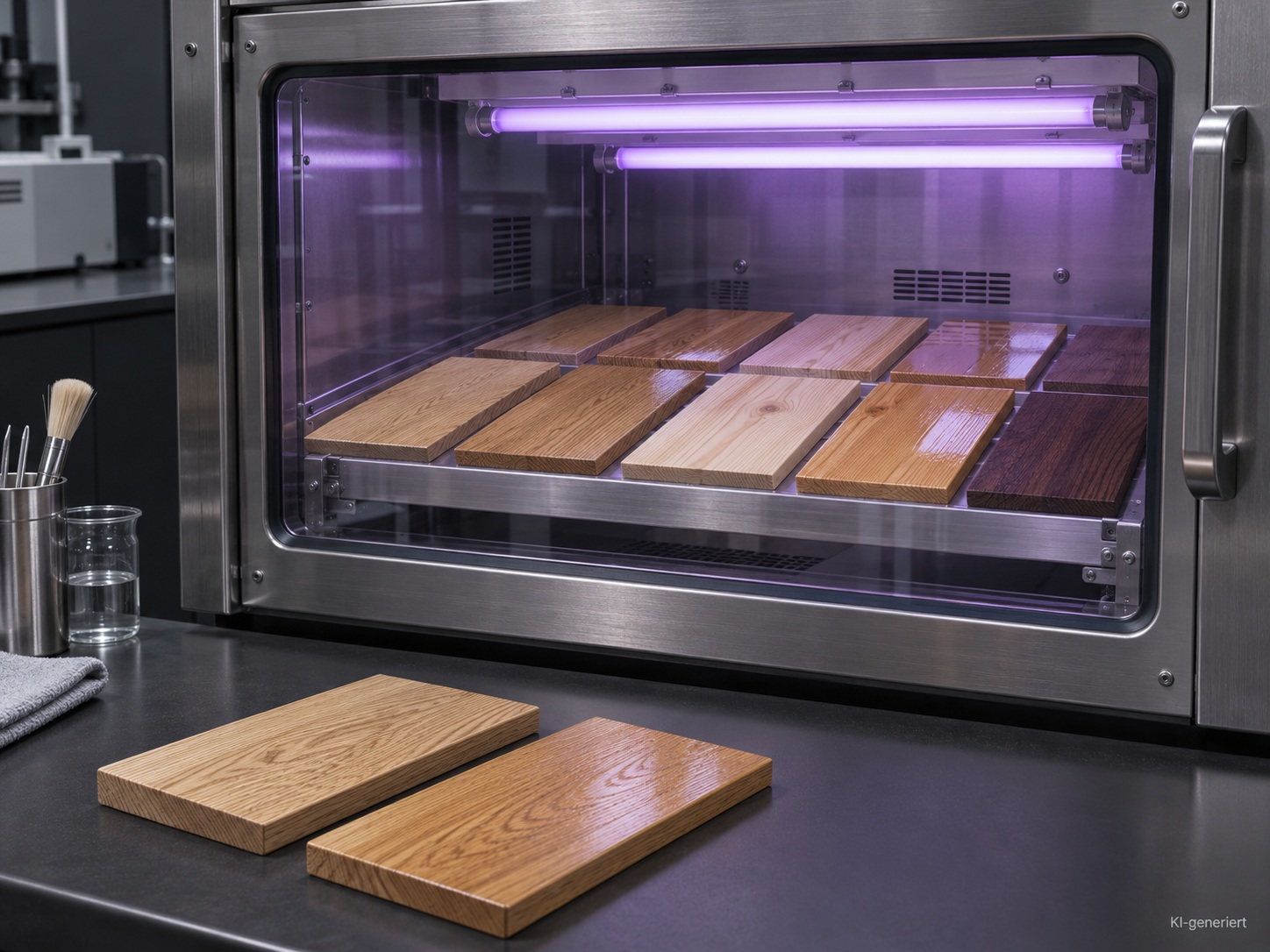
BF Engineering has practical experience in this field: together with Schreinerei Josef Eham GmbH, the company developed a compact UV test chamber for accelerated ageing tests on wood, paints and coated surfaces.
Compare changes in wood surfaces in a traceable way
Wood testing can cover untreated surfaces as well as oiled, stained or varnished finishes. Depending on the research question, investigations examine how appearance changes or how different treatments perform under the same exposure.
Testing is tailored to the intended application environment. Different light conditions may be relevant for furniture or interior fittings than for façades or other exterior components. Irradiation-only tests and combined weathering tests are therefore planned as different experimental tasks.
Typical areas of investigation:
- Colour development of untreated wood surfaces
- Comparison of different oils, stains and varnishes
- Investigation of transparent and pigmented surface treatments
- Comparison of wood species and processing variants
- Evaluation of surfaces before and after specified exposure stages
Account for natural material differences when planning specimens
Wood is a naturally grown material. Colour, structure and moisture content can vary even within a single species. These differences are considered when selecting and assigning specimens so that they interfere as little as possible with the evaluation of different treatments.
Documented initial conditions and suitable replicate specimens are useful for comparative experiments. Sanding condition, application quantity and drying of a surface treatment are also recorded. This makes it possible to establish subsequently which combination of wood and treatment was tested.
Important specimen information:
- Wood species and origin or specimen assignment
- Initial colour, grain and visible material characteristics
- Wood moisture content and conditioning state
- Surface preparation and sanding condition
- Type, application and drying of the surface treatment
Tailor the exposure profile to indoor or outdoor applications
The radiation reaching a wood surface in its intended application also depends on glazing, coatings and other intervening layers. The test concept therefore defines the relevant spectral conditions and which side of the specimen is irradiated.
Alongside light exposure, temperature and, where applicable, humidity or wetting phases are planned. If the interaction of several environmental influences is to be investigated, these must be specifically incorporated into the test programme. Exposure conditions are documented throughout the experiment.
Important exposure parameters:
- Radiation spectrum and application-specific filtering
- Irradiance and spatial distribution
- Exposure duration and radiant exposure
- Surface and ambient temperatures
- Humidity, wetting and drying phases, where applicable
Record colour development and surface condition together
Evaluation begins with a documented initial examination. Repeated photographs and suitable measurements can show how the surface develops over several exposure stages. Measurement locations are identified as clearly as possible, since the natural wood structure can produce local differences.
Depending on the test objective, the condition of a coating or other surface characteristics is investigated alongside colour. A colour change alone is not sufficient evidence of a change in load-bearing capacity or the overall service life of the component.
Possible evaluation parameters:
- Colour change at specified measurement positions
- Gloss and appearance of treated surfaces
- Cracking and changes in surface structure
- Condition and adhesion behaviour of existing coatings
- Comparison of different treatments after identical exposure
Adapt the system to specimen formats and workflows
Wood specimens can have different dimensions, thicknesses and surface constructions. The irradiation system is therefore tailored to the intended formats and the required comparison area. Specimens must be positioned in a defined way and remain accessible for intermediate evaluations.
BF Engineering plans irradiation equipment to suit the test objective and existing environment. The design considers operation, temperature monitoring and maintenance, as well as interfaces with supplementary climatic functions where applicable.
Relevant integration considerations:
- Specimen dimensions, material thicknesses and number of variants
- Defined mounting and repeatable positioning
- Access for photographic documentation and intermediate measurements
- Monitoring of irradiation and temperature
- Cleaning, maintenance and regular verification measurements
Any questions?
We're happy to help.
BF is a forward-looking company that specializes in the development, manufacture, and optimization of high-precision systems and specialized irradiation equipment for test benches.

Your contact person
Danelis Diaz
Management Backoffice

Never miss a thing
BF is a forward-looking company that specializes in the development, manufacture, and optimization of high-precision lighting systems and specialized illumination systems for test benches.