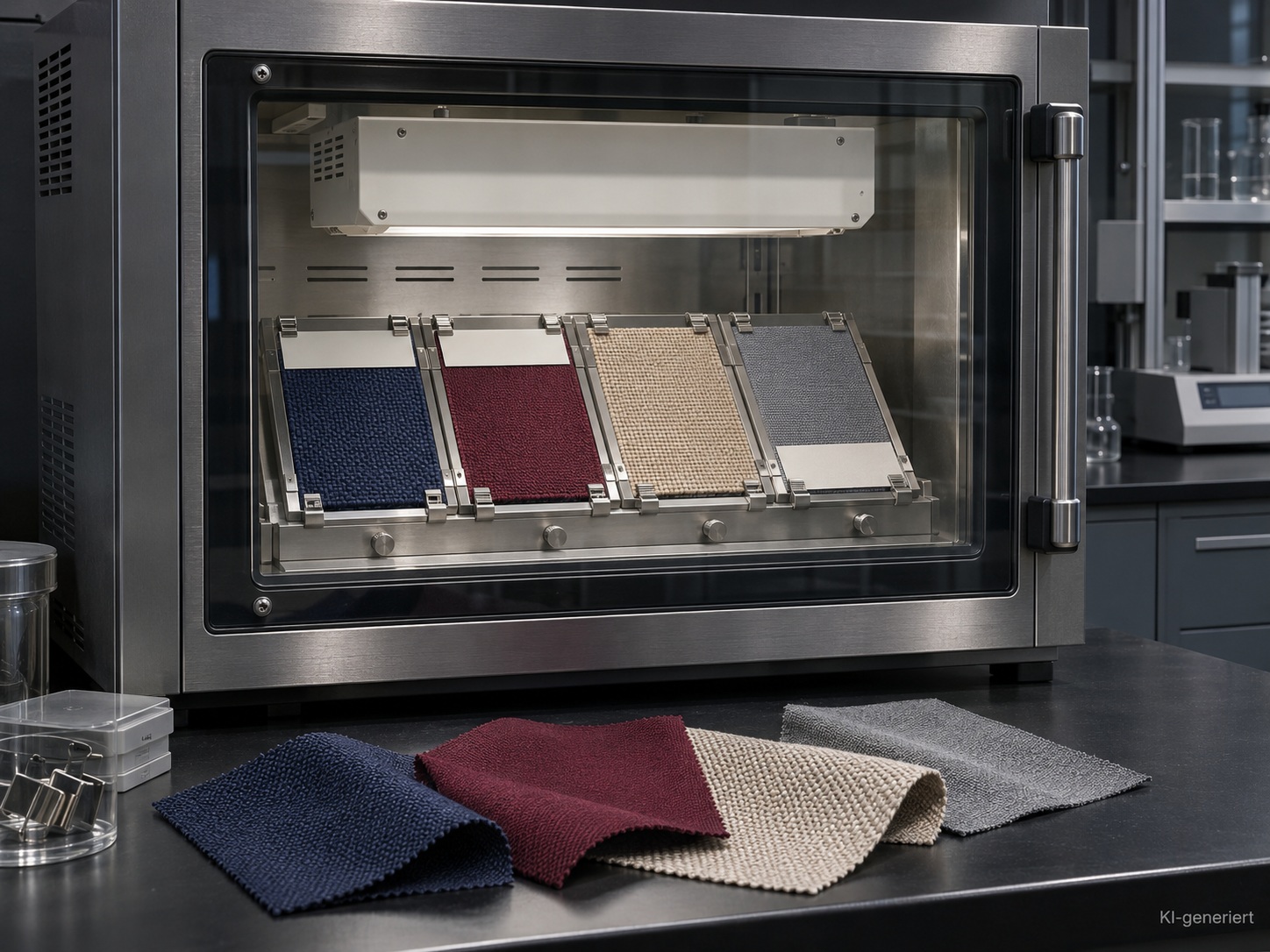
Textiles
Irradiation Testing for Textiles
Textiles are used in clothing, vehicles, interiors and outdoor applications. Depending on their use, requirements for colour, material and function differ considerably. Fibre composition, dyeing, finishes and coatings therefore also form part of the specimen description.
Defined irradiation allows comparative investigations independently of changing natural light conditions. A distinction must be made between lightfastness testing and broader investigations into material ageing. ISO 105-B02, for example, describes a method for evaluating colour changes in textiles under artificial, daylight-like xenon-arc light.
BF Engineering develops irradiation solutions for these investigations. Requirements for the light source, specimen mounting and ambient conditions are established to suit the agreed procedure.
Consider colour, material and application together
The properties to be investigated depend on the textile’s intended use. A decorative upholstery fabric raises different questions from a coated outdoor fabric or a technical textile with a specific function.
Comparative tests can examine different fibre blends, dyes, prints or finishes. Before exposure begins, the characteristics to be evaluated and the required references are defined. This creates an experimental programme suited to the specific product question.
Typical areas of investigation:
- Colour behaviour of dyed and printed textiles
- Comparison of different fibres and material blends
- Investigation of upholstery fabrics and interior textiles
- Comparison of coated or finished fabrics
- Evaluation of selected functions after defined exposure
Select illumination to suit the test objective
General UV irradiation does not automatically replace a specified lightfastness test procedure. The required light source and filtering are therefore selected according to the investigation objective and, where applicable, the agreed test specification.
Different conditions may be relevant for outdoor applications, interiors or exposure behind glazing. Alongside the spectrum, irradiance, temperature and the sequence over time are defined. Reference materials are included where required by the selected procedure.
Important exposure parameters:
- Radiation source and spectral requirements
- Filtering suited to the intended application
- Irradiance or the procedure-specific reference parameter
- Temperature and, where applicable, humidity conditions
- Exposure duration and required reference materials
Position flexible materials under defined conditions
Textile specimens require a mounting arrangement that reliably maintains their position during exposure. At the same time, unwanted stretching, folds and shading should be avoided. Mounting is therefore adapted to the material and the area being investigated.
The backing and layer construction can also influence the result. For multilayer products, it is established whether only the outer material or the complete composite will be investigated. Orientation, sampling and any masking are documented.
Relevant specimen mounting considerations:
- Dimensions and orientation of the textile specimen
- Defined tension or low-stress mounting
- Backing and multilayer construction, where applicable
- Flat positioning without folds and unobstructed exposure of the test area
- Identification and masking of designated comparison areas
Align evaluation with the property being investigated
In a lightfastness investigation, the focus is on colour change. Broader ageing investigations may require additional mechanical or functional tests. These are defined as separate evaluation steps.
Measurements before and after exposure are performed under agreed conditions. Demonstrating the UV-protective performance of a textile requires an appropriate measurement and evaluation procedure; an irradiation test alone does not establish a protection classification.
Possible evaluation parameters:
- Colour change according to the selected evaluation procedure
- Differences between exposed and reference areas
- Changes in the surface and condition of the coating
- Mechanical properties according to a separate test plan
- Retention of defined textile product functions
Coordinate the irradiation system with textile sample series
Textile testing can involve numerous small samples and comparison variants. A clearly organised sample arrangement and unambiguous identification make it easier to link exposure with results. Intermediate evaluations and repeated sample changes are also considered in the workflow.
BF Engineering plans the irradiation equipment to suit the required area and intended specimen holders. Requirements for temperature control, monitoring and interfaces are established together with the operator.
Relevant integration considerations:
- Number and format of specimens exposed simultaneously
- Suitable holders for flexible materials
- Accessibility for intermediate evaluations and specimen changes
- Monitoring of the agreed exposure conditions
- Cleaning, maintenance and verification of the irradiation area
Any questions?
We're happy to help.
BF is a forward-looking company that specializes in the development, manufacture, and optimization of high-precision systems and specialized irradiation equipment for test benches.

Your contact person
Danelis Diaz
Management Backoffice

Never miss a thing
BF is a forward-looking company that specializes in the development, manufacture, and optimization of high-precision lighting systems and specialized illumination systems for test benches.