Irradiation Testing for Spacecraft
Preparing rovers, landers and scientific hardware for their missions
Spacecraft are developed for very different operating environments. A lander on a planetary surface, a rover carrying scientific instruments and a system travelling through space each require an appropriate thermal test concept.
Irradiation testing supports the investigation of heating, temperature distribution and behaviour during defined operating phases. Depending on the task, it is combined with a climatic environment, reduced pressure or thermal vacuum testing.
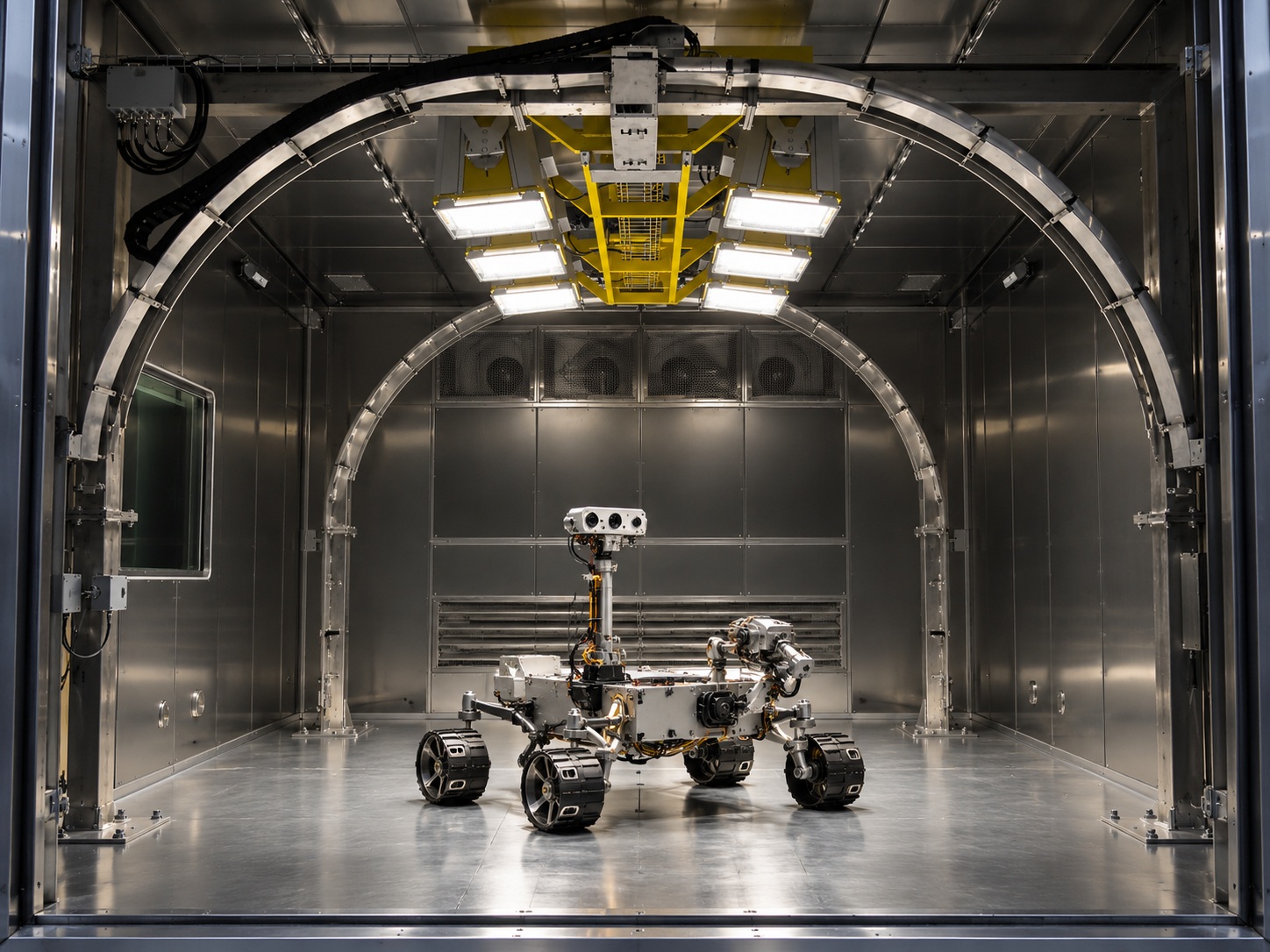
One documented example is the preparation of solar and thermal testing for the Curiosity Mars rover, where solar simulation was used as part of a coordinated space simulation environment.
The Mission Determines the Test Setup
An irradiation system is designed around the conditions relevant to the investigation. These include the radiation load, ambient temperatures, pressure and the operating states of the test object.
The development stage also plays a role: an early demonstrator can initially be investigated in an easily accessible laboratory setup. Later verification tests may introduce additional requirements concerning how representative the environment and the integrated system configuration must be.
This creates a test concept suited to the task — from an individual instrument to an assembled system.
Investigating mission-specific loads for rovers, landers and instruments
Spacecraft are developed for different mission phases and operating environments. Thermal requirements during transfer differ from those on a planetary surface. Instruments, electronics and structures within the same system may also have different permissible temperature ranges.
The test task therefore begins with the selection of relevant conditions. These may include an intensive irradiation phase, an extended cooling period or the operation of an instrument under specified environmental conditions.
Depending on the development stage, the focus may be on individual components, thermal models or integrated systems. The tests provide information about how heat is distributed throughout the assembly and whether the thermal concept supports the intended operating states.
System testing of the Curiosity Mars rover investigated both transfer conditions under vacuum and Martian surface conditions at reduced gas pressure. Solar simulation was used for selected hot and diurnal test cases.
Possible areas of investigation:
- Temperature distribution across structures and housings
- Thermal behaviour of scientific instruments
- Interaction between external irradiation and internal heat dissipation
- Behaviour during heating and cooling phases
- Functionality in selected operating and standby states
- Correlation of measurement data with thermal models
Deriving radiation conditions from the mission profile
For irradiation testing, intensity, spectral requirements and irradiation geometry are derived from the specific investigation. A test profile for a planetary surface may differ significantly from an investigation under orbital or interplanetary conditions.
In addition to a constant load, profiles that change over time may be relevant. These may include the build-up of a solar load, extended hold periods or the transition to reduced irradiation. The profile is defined according to the test objective.
The geometry of the spacecraft also influences the load. Sensor supports, masts, instruments and structural elements can cast shadows. Different irradiation directions therefore change the areas that are actually exposed.
During system design, radiation conditions are considered together with the thermal environment. A suitable light source alone does not reproduce the entire mission environment.
Important design parameters:
- Irradiance for the selected test cases
- Spectral requirements of the investigation
- Angle of incidence and orientation of the test object
- Load and unloading profiles over time
- Shading caused by instruments and structural elements
- Interaction with temperature and pressure conditions
Compact test setups with sufficient space for development
A compact test setup may be suitable for instruments, assemblies and smaller demonstrators. It provides convenient access and makes modifications easier during development testing.
The usable space must accommodate not only the test object but also its mounting, instrumentation and required movement ranges. On rover models, for example, mast structures or scientific assemblies may influence the required height and possible luminaire positions.
Adjustable irradiation directions can be achieved through suitable luminaire positions or defined positioning of the test object. The most appropriate solution depends on the size, mass and sensitivity of the assembly.
Interfaces for subsequent tests in a different chamber environment should be considered as early as possible. These include mounting arrangements, measurement cables and documentation of the actual configuration.
System design priorities:
- Sufficient space for the test object and instrumentation
- Consideration of masts, instruments and attached components
- Defined mounting and repeatable positioning
- Suitable arrangements for different irradiation directions
- Accessible measurement points and protected cable routing
- Adaptation to laboratory, climatic or vacuum environments
Linking thermal responses to functional phases
A spacecraft generates different amounts of internal heat depending on its operating state. An active instrument, a data processing unit or a heating system changes the thermal conditions within the assembly.
Temperature measurements are therefore linked to the respective functional states and external load phases. This makes it possible to distinguish whether a change was caused by irradiation, test object operation or a change in environmental conditions.
Both steady states and transitions are relevant to the evaluation. Heating rates, time delays and temperature differences between measurement points can provide insights into thermal behaviour.
Measurement data from steady-state and transient test phases is also used in actual rover test programmes to correlate analytical models.
Relevant measurement and documentation parameters:
- Temperatures at housings, structures and instruments
- Development over time during heating and cooling
- Operating states and electrical power consumption
- Irradiation profile and test object orientation
- Temperature and pressure conditions in the test environment
- Configuration of mountings, sensors and cables
Preparing the test setup for changing development tasks
Development programmes evolve: instruments are added, assemblies are replaced and test profiles are refined. Planning should therefore consider which adjustments are likely to be needed during subsequent operation.
These include accessible connections, sufficient space for instrumentation and clearly defined positioning options. Transferring recurring test parameters into the test control system can also make it easier to compare several development versions.
For technical integration, the irradiation equipment, chamber environment and test object operation are coordinated. Setpoints and measurement data require a common time reference so that the test procedure can subsequently be evaluated.
BF Engineering supports the design of the irradiation equipment and its integration into the intended test environment. The specific scope is defined according to the mission, test object and existing infrastructure.
Relevant aspects of integration:
- Mechanical mounting arrangements and available installation positions
- Connections for irradiation, instrumentation and test object power supply
- Coordination with temperature and pressure control
- Common time reference for test phases and measurement data
- Options for adaptation to subsequent development versions
- Operating, safety and maintenance concept
Any questions?
We're happy to help.
BF is a forward-looking company that specializes in the development, manufacture, and optimization of high-precision systems and specialized irradiation equipment for test benches.

Your contact person
Danelis Diaz
Management Backoffice

Never miss a thing
BF is a forward-looking company that specializes in the development, manufacture, and optimization of high-precision lighting systems and specialized illumination systems for test benches.