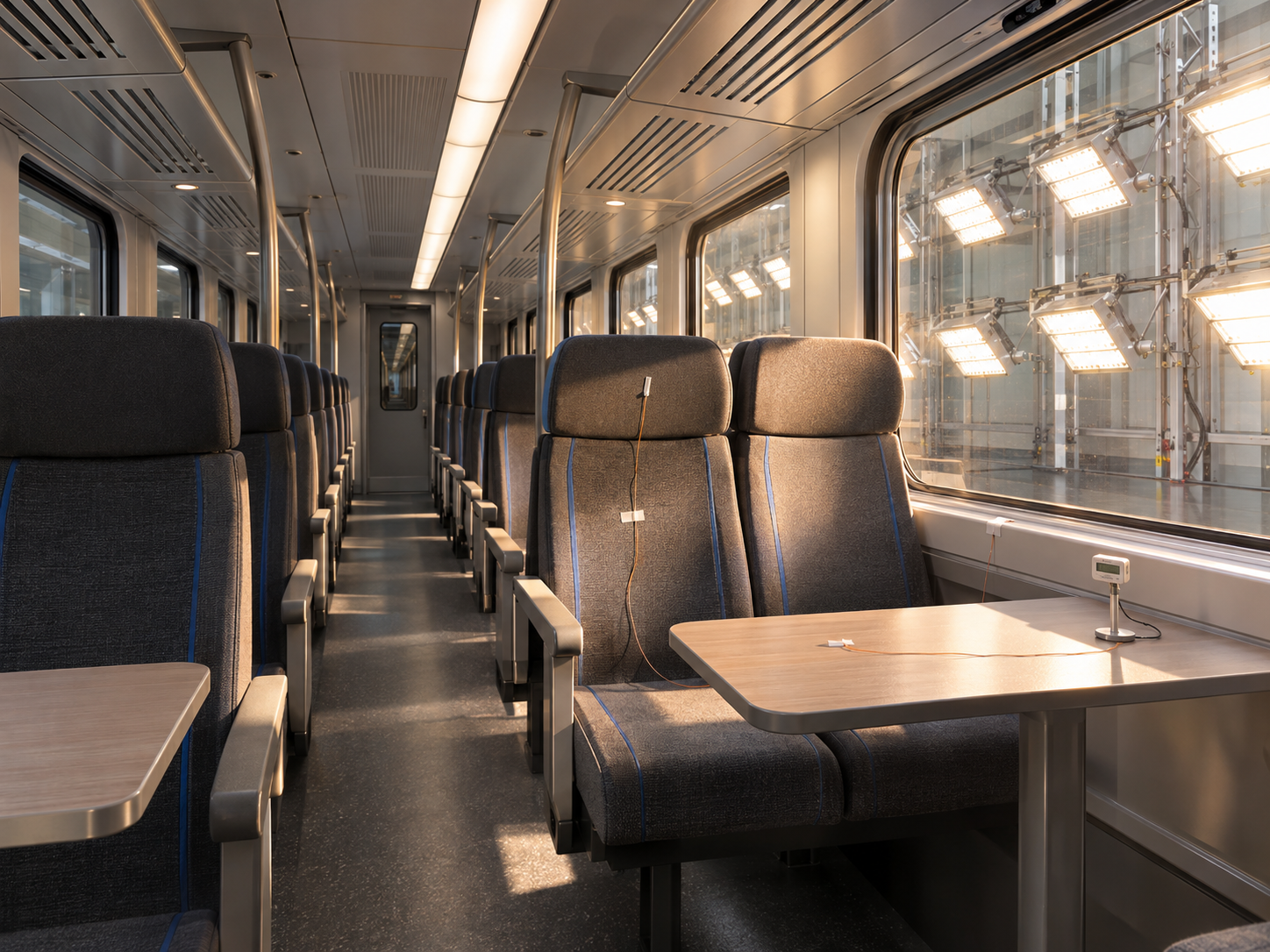
Interior
Solar Load Testing for Rail Vehicle Interiors
Large windows, different seating arrangements and changing irradiation directions shape the thermal conditions inside a train. While a seat near a window may be exposed to direct solar radiation, conditions in the aisle can be considerably different. Heated panels, tables and seat surfaces also influence conditions for passengers and staff.
Defined irradiation makes it possible to investigate these influences under comparable conditions. Air temperatures, surface temperatures and other relevant parameters are considered together. This allows differences between occupied areas to be identified and the effects of glazing, interior fittings and sun protection to be evaluated systematically.
BF Engineering supplies irradiation equipment for these test setups. The design is tailored to the interior area being investigated, the vehicle geometry and the requirements of the respective measurement task.
Identify local differences within the passenger compartment
An average interior temperature only partially describes the thermal conditions inside a vehicle. Passengers can experience different conditions at the same air temperature, for example due to direct solar radiation, heated surfaces or local differences in air movement.
Interior tests therefore examine specific occupied areas. These include window seats, aisle areas, entrance zones and the driver’s cab. Measurement positions are selected to capture relevant differences within the area under investigation.
Under defined irradiation conditions, it is then possible to investigate the effects of changes to air distribution, sun protection or interior fittings. For a comprehensive comfort assessment, the measurement parameters and evaluation criteria must be established in the test concept.
Typical areas of investigation:
- Thermal differences between window seats and aisle areas
- Temperature distribution at different heights and in different occupied zones
- Influence of heated surfaces on local conditions
- Development of interior conditions during an irradiation phase
- Effects of changes to air distribution or air conditioning settings
Investigate heat input through windows and sun protection
Glazing influences how much of the incident radiation enters the interior and how much is reflected or absorbed by the glass. This changes both the temperature of the glazing and the load on the seats and surfaces behind it.
A suitable test setup allows different glazing and sun protection configurations to be compared. Irradiation direction, intensity, exposure duration and ambient conditions are kept as consistent as possible. The position of blinds or other sun protection elements must also be clearly documented.
For meaningful comparisons, the spectral suitability of the irradiation must be checked. Different glazing types can respond differently to the wavelength distribution of the radiation source. The irradiation equipment must therefore be selected to suit the intended comparison.
Possible areas of investigation:
- Temperature development at the glazing
- Heating of seats, tables and panels behind the window
- Thermal conditions in the adjacent occupied area
- Comparison of different glazing and sun protection configurations
- Influence of different irradiation directions and sun protection positions
Compare the heating behaviour of interior surfaces
Seats, wall panels, tables and floor areas can heat up to different degrees under irradiation. In addition to material and colour, surface texture, component construction and heat dissipation influence their temperature behaviour.
Defined irradiation tests allow selected interior fitting variants to be compared. Investigations can examine how quickly a surface heats up, which temperatures develop under specified conditions and how it cools down after irradiation ends.
Tests can be carried out on individual components or with the components installed. Testing inside the vehicle also takes account of influences such as installation position, adjacent components and airflow. If colour changes or light-induced ageing processes are also to be investigated, the radiation spectrum, exposure procedure and evaluation criteria must be defined separately.
Typical test specimens and comparison parameters:
- Seat upholstery, seat shells and armrests
- Wall, ceiling and window panels
- Tables, storage surfaces and floor areas
- Control surfaces and components in the driver’s cab
- Heating rate, surface temperature and cooling behaviour
Capture thermal conditions using suitable measurement parameters
Measurement planning depends on whether the objective is to compare components, investigate a seating area or carry out a more comprehensive interior assessment. Measurement points are established on surfaces and in the relevant occupied zones accordingly.
In addition to air and surface temperatures, relative humidity, air velocity and suitable parameters for assessing the thermal radiant environment can be recorded. Sensors must be selected to suit the measurement task, and their installation positions must be documented. When measuring air temperature, for example, direct effects of irradiation on the sensors must be taken into account.
For subsequent evaluation, measurement data are linked to the irradiation profile and the operating state of the air conditioning. This makes it possible to identify whether a temperature change results from a change in external load, a control response or another change in the test sequence.
Important measurement and documentation parameters:
- Position and mounting of the sensors used
- Air and surface temperatures in the areas under investigation
- Relative humidity and air velocity as required by the test objective
- Irradiation conditions and exposure profile over time
- Air conditioning operating state and documented interventions during the test
Reproduce the relevant interior situation in a clearly defined way
Interior tests can be carried out on a complete vehicle, a vehicle section or a suitable partial setup. The appropriate option depends on which interactions are essential to the investigation.
A partial setup can, for example, facilitate comparisons between glazing types and the surfaces behind them. Investigations into air distribution or interaction with the vehicle’s air conditioning may require a more extensive setup. The limitations of the respective representation should be considered during planning.
Defining the test conditions also includes specifying the interior fittings, irradiation direction and initial temperatures. If additional internal heat loads are planned, their power and position must also be defined. This creates a test setup suited to the investigation and supports recurring comparative tests.
Relevant planning considerations:
- Interior, seating or component area under investigation
- Glazing configuration and sun protection position
- Interior fittings, installation position and adjacent surfaces
- Irradiation direction, intensity and exposure duration
- Air conditioning state and, where applicable, additional internal heat loads
Any questions?
We're happy to help.
BF is a forward-looking company that specializes in the development, manufacture, and optimization of high-precision systems and specialized irradiation equipment for test benches.

Your contact person
Danelis Diaz
Management Backoffice

Never miss a thing
BF is a forward-looking company that specializes in the development, manufacture, and optimization of high-precision lighting systems and specialized illumination systems for test benches.