Thermal Testing
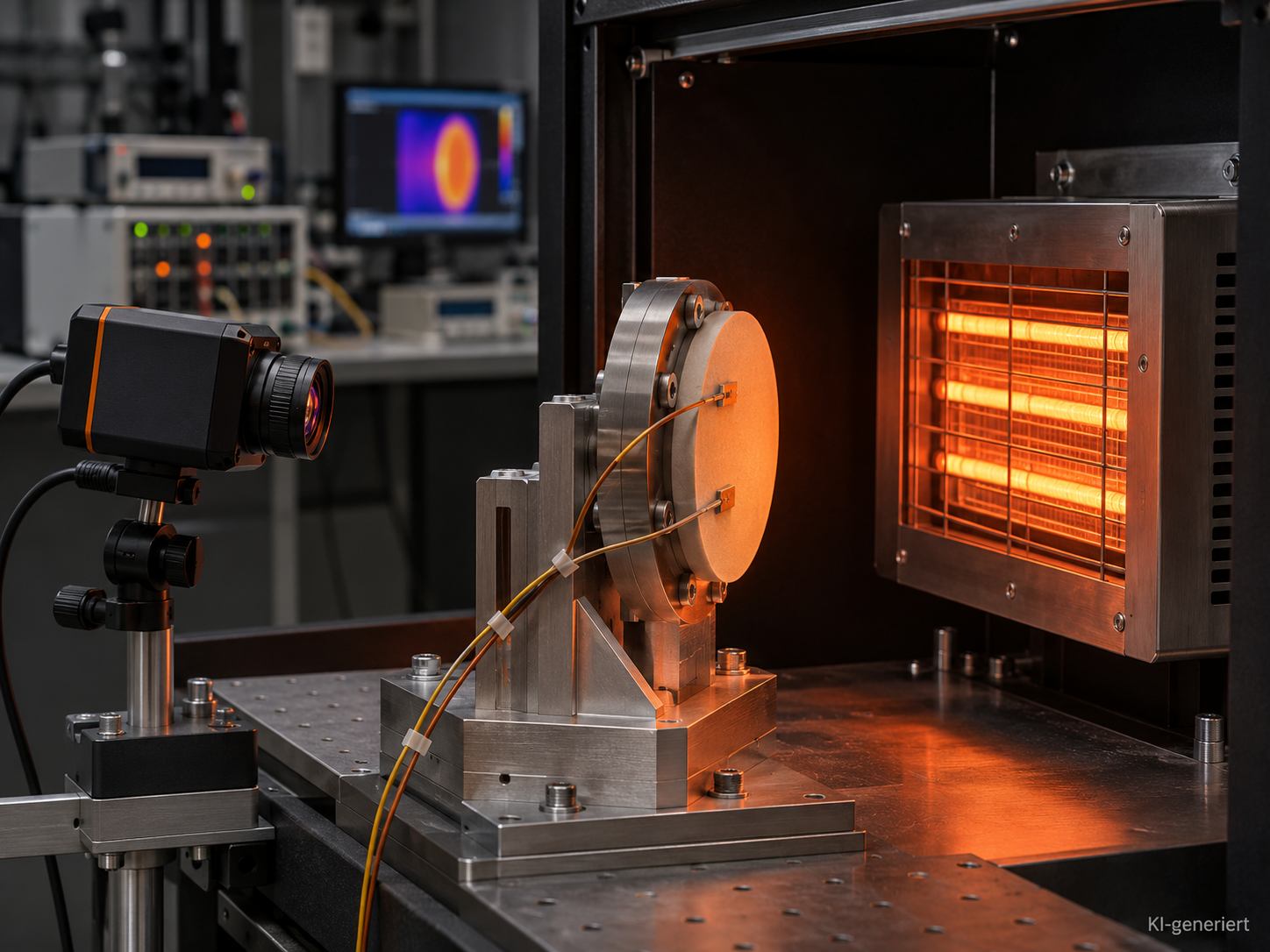
Radiant Thermal Testing for Research and Laboratories
Thermal loads influence materials, components and technical systems. Development and research tasks often focus on how quickly a specimen heats up, which temperature differences occur and how these affect its properties or function.
Radiant thermal testing allows energy to be applied to a surface in a targeted way. The resulting temperature depends on the specimen and its boundary conditions. The radiation source, geometry, mounting and temperature measurement are therefore planned together.
BF Engineering develops infrared irradiation systems for generating defined thermal loads. The design is tailored to the research task, specimen geometry and intended load profile.
Understand the specimen’s thermal response
Thermal tests can investigate the behaviour of individual material samples as well as the function of complete components. Depending on the research question, the focus may be on heating rate, local temperature differences or behaviour during an extended loading phase.
Defined experimental conditions allow different variants to be compared. During planning, it is established whether specimens should be subjected to the same incident radiation load or a comparable temperature profile. This distinction is essential for experimental planning and subsequent evaluation.
Typical areas of investigation:
- Heating and cooling behaviour of materials and components
- Temperature distribution across surfaces and within assemblies
- Comparison of different coatings and design variants
- Functional behaviour during thermal loading
- Provision of measurement data for thermal simulation models
Coordinate the radiation source and specimen
How strongly a specimen heats up under irradiation depends on the proportion of incident radiation it absorbs and how heat is subsequently conducted or released. Different materials and surfaces can therefore reach different temperatures under the same external load.
The design considers the source’s spectral characteristics, distance, irradiation direction and irradiated area. For three-dimensional components, shading and different surface orientations are also examined. This establishes which areas are to be loaded selectively.
Key design parameters:
- Spectral characteristics of the radiation source
- Irradiance or incident power density
- Size and position of the surfaces to be heated
- Distance, irradiation direction and specimen contour
- Heat absorption and heat dissipation of the setup under investigation
Clearly define target parameters and the control strategy
For a temperature-controlled test, the measurement point providing the governing feedback signal is defined. A single surface temperature does not automatically describe the condition of the entire specimen. Additional measurement points may therefore be needed to capture spatial differences.
Depending on the task, a specified irradiation profile or regulation to a target temperature may be used. Heating phases, holding times and cooling conditions are defined to suit the investigation objective. Achievable profiles also depend on heat capacity, thermal conduction and the available heat dissipation.
Relevant temperature control specifications:
- Defined measurement and control positions
- Target temperatures and permissible deviations
- Required heating phases and holding times
- Specified cooling conditions between loading phases
- Additional limits for sensitive specimen areas
Measure temperatures using methods suited to the surface and research question
The measurement method is selected according to temperature range, surface characteristics and accessibility. Contact sensors require suitable mounting and can be locally affected by irradiation. Their arrangement is therefore defined together with the experimental setup.
For non-contact methods, surface properties and reflected radiation must be considered, among other factors. Combining different measurement methods can allow local temperature profiles and larger areas to be examined together. The measurement strategy must be tailored to the respective specimen.
Important measurement and documentation parameters:
- Temperature profiles at defined measurement points
- Spatial temperature distribution as required by the measurement task
- Mounting and position of contact sensors
- Surface-related settings and measurement geometry for non-contact methods
- Time correlation of emitter operation, temperature and functional data
Incorporate thermal radiation into the existing test setup
The irradiation system is coordinated with specimen mounting, the measurement system and, where applicable, additional loading equipment. Both direct irradiation of the specimen and additional heating of its surroundings are considered.
BF Engineering plans the radiation source arrangement and associated interfaces to suit the laboratory environment. Required clearances for sensors and specimen changes are considered alongside heat removal and maintenance access.
Relevant integration considerations:
- Mechanical mounting and alignment of the radiation source
- Specimen mounting and access to measurement instrumentation
- Electrical supply and heat removal
- Controls, temperature monitoring and coordinated protective functions
- Accessibility for modifications, maintenance and verification measurements
Any questions?
We're happy to help.
BF is a forward-looking company that specializes in the development, manufacture, and optimization of high-precision systems and specialized irradiation equipment for test benches.

Your contact person
Danelis Diaz
Management Backoffice

Never miss a thing
BF is a forward-looking company that specializes in the development, manufacture, and optimization of high-precision lighting systems and specialized illumination systems for test benches.