Air Conditioning Systems
Investigate cooling behaviour, control performance and energy demand under defined solar loads.
The air conditioning system of a rail vehicle must respond to changing external conditions and varying internal heat loads. Solar radiation increases heat input through the vehicle body and glazing, influencing the required cooling capacity. At the same time, thermal conditions in the relevant occupied areas should remain as stable as possible.
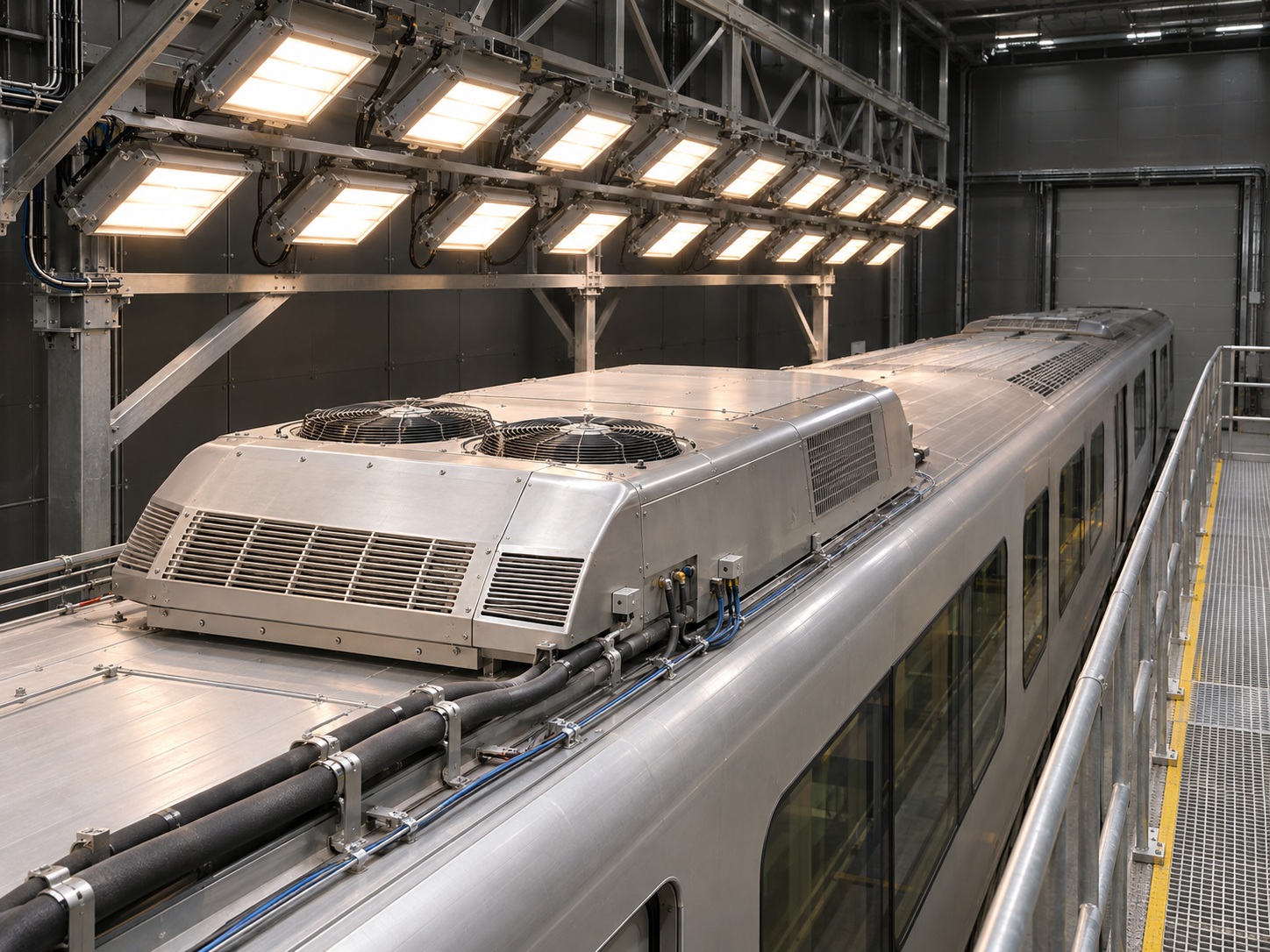
A suitably designed solar simulation system provides defined external loads for these investigations. Combined with the rest of the test environment, it allows the cooling behaviour of a heated vehicle, temperature maintenance during operation and responses to changing loads to be examined.
BF Engineering develops irradiation equipment for these test applications. The design is tailored to the vehicle, the test sequence and the interfaces with the existing climatic test environment.
Evaluate air conditioning under sustained solar loading
Under solar irradiation, the vehicle continuously absorbs heat. The air conditioning system must handle this heat input alongside other external and internal loads. It is therefore relevant to investigate how interior conditions develop under a defined load.
A typical test sequence starts with a specified heating phase. The investigation then examines how quickly the air conditioning achieves the defined target conditions. Operation under sustained irradiation can additionally show whether these conditions are maintained throughout the intended test period.
Evaluating vehicle behaviour and determining cooling capacity through measurement are different tasks. While cooling behaviour can be described using interior measurements, determining the actual cooling capacity requires a suitable measurement setup.
Typical areas of investigation:
- Cooling profile after a defined heating phase
- Time required to achieve specified interior conditions
- Temperature distribution during cooling operation
- Stability of conditions under sustained irradiation
- Behaviour under different external and internal heat loads
Investigate responses to changing loads in a clearly defined way
During operation, the demands on the air conditioning system change continuously. Changes in solar loading, additional internal heat loads or transitions between operating states may require adjustments to cooling capacity, airflow rate and air distribution.
Defined test profiles make it possible to investigate how the control system responds to these changes. Parameters can include response time, temporary temperature deviations and subsequent stabilisation. Differences between individual vehicle zones may also be relevant.
To compare different software versions or control parameters, load profiles and initial conditions must be sufficiently consistent. The changes over time that the irradiation system needs to reproduce are established during its design.
Possible areas of investigation:
- Response to changes in solar loading
- Time required for stabilisation after a load change
- Temporary deviations from specified target conditions
- Transitions between different operating states
- Comparison of different control parameters and software versions
Consider achieved interior conditions and energy use together
An air conditioning strategy is not evaluated solely on the temperatures it achieves. The electrical energy required and the load conditions under which the system operates are equally relevant.
Defined test sequences allow different operating strategies to be compared under comparable conditions. Power consumption and interior conditions are recorded over the same period. In addition to individual power peaks, energy consumption over the complete test sequence is particularly informative.
For a meaningful comparison, the scope of the system being assessed must be clearly defined. Depending on the measurement task, compressors, fans, pumps and other auxiliary consumers may be included. Differences in interior temperatures or load profiles must be taken into account when evaluating the results.
Relevant evaluation parameters:
- Electrical power consumption of the components being assessed
- Energy consumption over the defined test period
- Achieved temperature conditions and, where applicable, thermal comfort conditions
- Load profile and duration of the individual operating phases
- Comparison of operating strategies under matching boundary conditions
Clearly define external loads and vehicle states
The meaningfulness of an air conditioning test depends largely on its defined boundary conditions. Ambient temperature, humidity, irradiation and the initial state of the vehicle influence both cooling behaviour and energy demand.
Depending on the test objective, additional influences may be included. These can comprise airflow around the vehicle, additional internal heat loads or specified door-opening sequences. These conditions must suit the investigation objectives and be clearly described in the test sequence.
When individual air conditioning units are tested, the thermal load is applied using a suitable unit test bench. Irradiating a complete vehicle and reproducing a load on an individual air conditioning unit serve different purposes. If a relationship between the two tests is to be established, the load assumptions and system boundaries must be coordinated.
Important boundary conditions:
- Ambient temperature and humidity
- Solar loading, spatial distribution and profile over time
- Initial temperatures and prior conditioning of the vehicle
- Internal heat loads and defined vehicle configuration
- Operating states, setpoints and, where applicable, additional load changes
Coordinate irradiation, the climatic test environment and data acquisition
To ensure that solar simulation supports the test sequence effectively, the irradiation equipment, climatic chamber and measurement equipment are considered together. The planned operating phases determine when irradiation must be available and how its states should be recorded in the test log.
In addition to the electrical supply, the system’s additional heat release must be considered. This influences the requirements placed on the test environment and must be included in its design. Luminaire positions must also be coordinated with airflow around the vehicle, measurement points and the required access areas.
BF Engineering designs the irradiation equipment and coordinates the associated interfaces with the system partners involved. Depending on the project, these include control signals, status messages, enable signals and the time correlation of irradiation states with recorded measurement data.
Relevant integration considerations:
- Irradiation area, luminaire arrangement and distance from the vehicle
- Electrical supply and additional heat release
- Coordination with airflow, sensors and maintenance areas
- Control interfaces, enable signals and status messages
- Time correlation of load states and measurement data
Any questions?
We're happy to help.
BF is a forward-looking company that specializes in the development, manufacture, and optimization of high-precision systems and specialized irradiation equipment for test benches.

Your contact person
Danelis Diaz
Management Backoffice

Never miss a thing
BF is a forward-looking company that specializes in the development, manufacture, and optimization of high-precision lighting systems and specialized illumination systems for test benches.