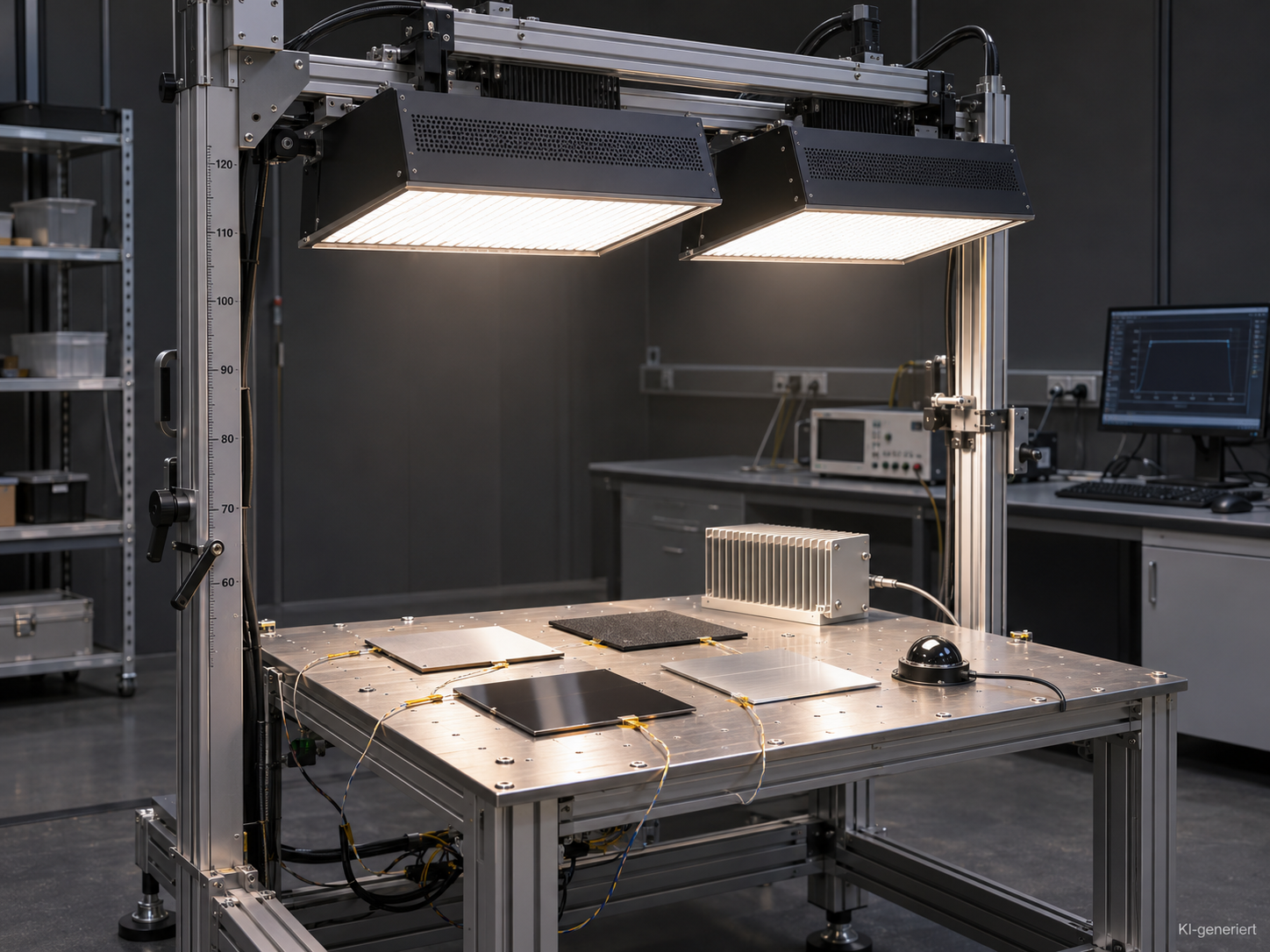
Solar Simulation
Solar Simulation for Research and Laboratories
Solar radiation influences the temperature, behaviour and function of many materials and technical systems. For scientific investigations, it is therefore important to control these influences and distinguish them from other experimental variables.
Solar simulation provides defined irradiation conditions in the laboratory. Intensity, irradiated area and the profile over time are established to suit the research question. This allows different materials, designs or operating states to be investigated under comparable conditions.
BF Engineering develops irradiation systems for research institutions and development centres. The design is based on the required radiation characteristics, specimen geometry and integration into the respective experimental setup.
Use solar loading as a defined experimental variable
Research experiments often aim to establish how radiation affects a particular process or specimen. Controlled irradiation makes it possible to vary this parameter systematically and observe the response under specified boundary conditions.
Investigations can range from the heating behaviour of a surface to the function of an irradiated sensor. The research question determines which characteristics of natural solar radiation need to be reproduced. Not every investigation requires the same spectral accuracy or profile over time.
Typical research tasks:
- Thermal behaviour of materials and components
- Comparison of different surfaces and coatings
- Functional investigations of irradiated components
- Investigation of shading and irradiation direction
- Development and verification of simulation models
Derive spectral requirements from the experimental objective
Spectral distribution describes how radiation is distributed across different wavelengths. It is relevant because materials and sensors do not respond equally to all wavelengths. A suitable total irradiance alone is therefore insufficient for some research tasks.
During planning, the spectral ranges relevant to the experiment and the applicable reference conditions are defined. The radiation source and, where required, optical filters are selected accordingly. Requirements for specialised applications are defined separately.
Important spectral requirements:
- Wavelength ranges relevant to the investigation
- Required reference spectral distribution
- Sensitivity of the materials or sensors used
- Requirements for ultraviolet, visible and infrared radiation components
- Suitable spectral verification and measurement methods
Set the area, direction and profile over time to suit the experiment
An experimental setup requires a clearly defined irradiation area. Depending on specimen geometry, the investigation may involve a flat sample, a three-dimensional component or a larger assembly. The luminaire arrangement is tailored to this geometry and the required irradiation directions.
The profile over time also forms part of the design. Some experiments require a load that remains as constant as possible, while others require specified changes or alternating irradiation and rest phases. The profiles to be implemented are agreed in advance in coordination with the experimental sequence.
Key design parameters:
- Dimensions and position of the irradiation area
- Irradiance and spatial distribution
- Irradiation direction and distance from the specimen
- Constant exposure or defined profiles over time
- Repeatable settings for comparative experiments
Link input conditions with the specimen’s response
For evaluation, the radiation load to which the specimen was exposed must be traceable. Suitable reference positions and measurement methods are therefore established. Where required, spectral distribution is also checked.
The specimen’s response is recorded using the relevant measurement parameters. These may include temperatures, electrical signals or other functional parameters. A common time reference makes it easier to compare changes in loading with changes in the specimen.
Important measurement and documentation parameters:
- Irradiance at the agreed reference positions
- Spectral measurement data as required by the investigation
- Specimen and ambient temperatures
- Functional or output signals from the system under investigation
- Time correlation of irradiation and measurement data
Integrate solar simulation into the research setup
Research facilities often consist of several subsystems. Irradiation must therefore be coordinated with specimen mounting, climate control, sensors and data acquisition. Access for modifications and new experimental configurations is also considered.
BF Engineering plans irradiation equipment to suit the existing environment. Required interfaces and adjustment options are defined according to the planned experiments. This allows the system to be tailored to the current research task while potential future adaptations can be considered during planning.
Relevant integration considerations:
- Installation space and mechanical mounting
- Interfaces with climate control and experimental controls
- Electrical supply and additional heat load
- Accessibility for instrumentation and modifications
- Coordinated operating, monitoring and protective functions
Any questions?
We're happy to help.
BF is a forward-looking company that specializes in the development, manufacture, and optimization of high-precision systems and specialized irradiation equipment for test benches.

Your contact person
Danelis Diaz
Management Backoffice

Never miss a thing
BF is a forward-looking company that specializes in the development, manufacture, and optimization of high-precision lighting systems and specialized illumination systems for test benches.