Climatic Wind Tunnels
Sun. Airflow. Temperature. Under controlled conditions.
A vehicle is standing in direct sunlight. The interior heats up, surfaces store heat, and the air conditioning system has to work hard. As soon as the vehicle starts moving, the airflow changes the heat exchange. In the next traffic jam, this cooling effect is lost again. On the road, these influences act simultaneously and change continuously.
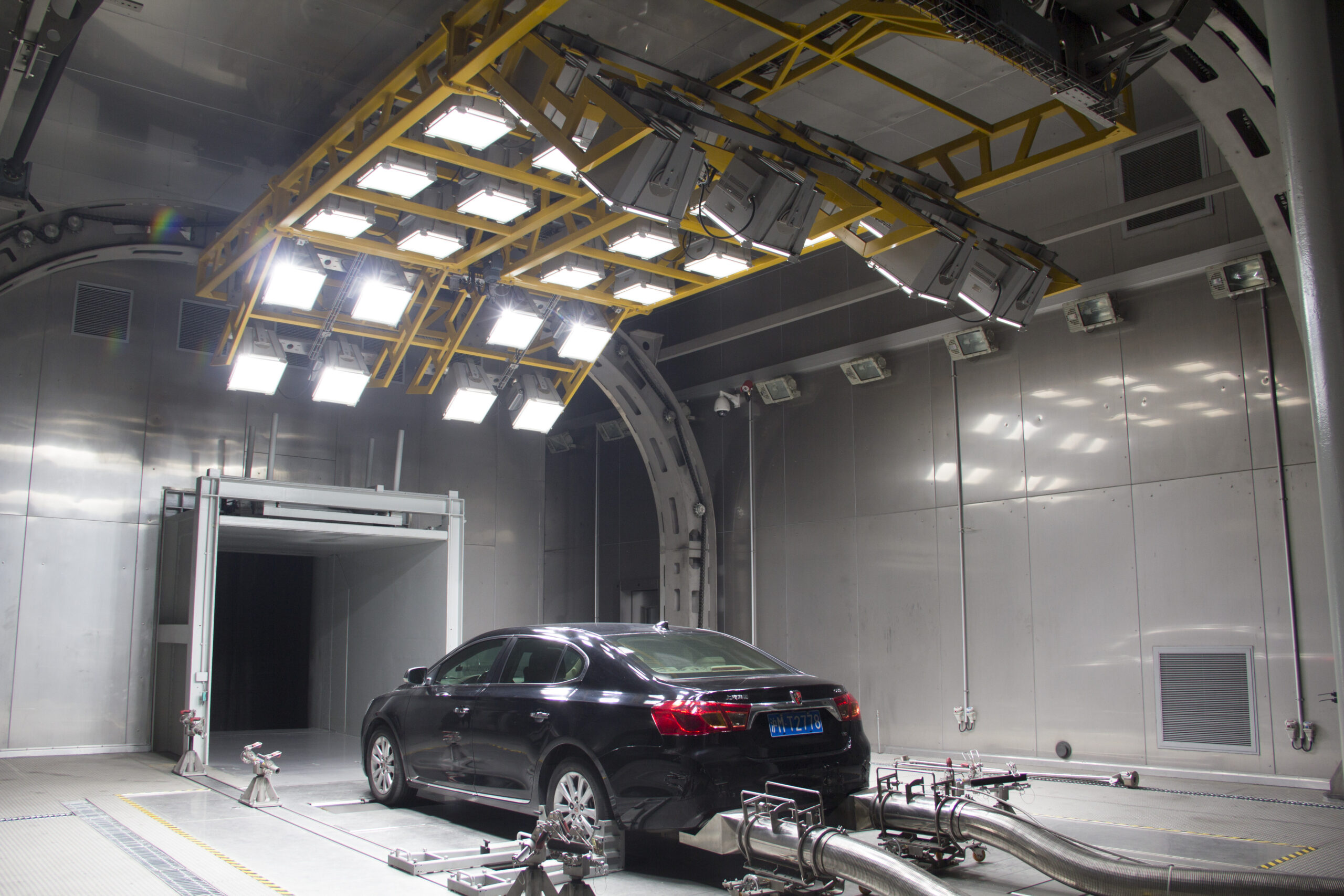
In a climatic wind tunnel, these situations can be reproduced in a targeted manner. Airflow, temperature and, depending on the equipment, additional climatic parameters are combined with defined vehicle operating conditions. An integrated solar simulation system adds a decisive factor: the solar radiation load. This allows developers to investigate how vehicles respond to heat, airflow and solar irradiation under comparable conditions.
BF Engineering develops and integrates solar simulation systems for this demanding test environment. The focus is on appropriate irradiation, mechanical engineering adapted to the wind tunnel, and integration into existing test facility operations.
Why the sun is essential in a wind tunnel
A high air temperature alone only partially reproduces a sunny summer day. Solar radiation strikes the bodywork and glazing and, depending on the material, is reflected, transmitted or absorbed, thereby influencing how the vehicle heats up.
At the same time, airflow changes heat transfer at the exterior surfaces and the air supplied to the cooling systems. A stationary vehicle therefore behaves differently in thermal terms from the same vehicle travelling at higher speeds.
This interaction is crucial for development: How does the air conditioning system perform after a heat-soak phase? How does cooling demand change under load? What temperatures occur at specific surfaces? And what effect does a modified control strategy have?
The climatic wind tunnel makes it possible to investigate these questions under defined conditions and to repeat tests. This makes differences between vehicle variants, components and software versions easier to compare.
The strength lies in the interaction: defined irradiation, controlled airflow and a reproducible test procedure.
Customers who trust us
View all referencesBringing road situations to the test bench in a targeted manner
In a climatic wind tunnel, different environmental and operating conditions can be combined. The tests that can be performed depend on the equipment of the individual tunnel, such as its climate control system, airflow system and chassis dynamometer.
For the investigation of thermal processes, changes in conditions over time are particularly relevant. A stationary heat-soak phase places different demands on the vehicle from subsequent driving under load. Alternating between driving and standstill can also be important when evaluating cooling and air conditioning.
Solar simulation adds a defined radiation load to the test procedure. Irradiance, exposure duration and vehicle position are specified to suit the measurement task.
Typical test situations:
- Heating of a parked vehicle under solar irradiation
- Cooling of the interior after the air conditioning is switched on
- Driving operation under combined thermal and mechanical loads
- Alternation between standstill and different airflow speeds
- Comparison of different vehicle configurations under identical boundary conditions
Understanding heat flows throughout the vehicle
Several thermal tasks must be managed simultaneously within a vehicle. The powertrain, cooling system and interior place different demands on heat dissipation and climate control. In electrified vehicles, the thermal operating conditions of the battery are another factor.
These interactions can be investigated at complete-vehicle level in a climatic wind tunnel. Vehicle load and airflow can be combined with defined climatic conditions. Solar simulation adds the external heat load.
The test environment therefore supports the evaluation of cooling concepts and control strategies. The combined assessment of vehicle condition, environmental conditions and measured temperatures is essential.
Possible areas of investigation:
- Vehicle cooling under different operating conditions
- Thermal behaviour of the battery and powertrain
- Influence of airflow on cooling demand
- Interaction between interior air conditioning and thermal management
- Comparison of control strategies and development versions
External influences are felt inside
Solar irradiation influences the thermal conditions inside a vehicle. When evaluating climate comfort, both air temperatures and the temperatures and radiative properties of the surrounding surfaces are therefore relevant.
A defined solar load makes it possible to investigate heating and cooling processes under repeatable conditions. Different glazing types, interior configurations and climate control strategies can therefore be compared more systematically.
The climatic wind tunnel provides an environment in which air conditioning and vehicle operation can be considered together. The variables to be measured depend on the specific development task.
Typical questions:
- How does the interior temperature develop during a heat-soak phase?
- How quickly does the air conditioning system reach the specified target conditions?
- What differences occur between different areas of the vehicle?
- How does an alternative climate control strategy change the temperature profile?
- What effect do different glazing and equipment variants have?
The right radiation for each test task
A solar simulation system must be adapted to the measurement task and the geometry of the test facility. This includes the required irradiance, the usable reference area, the spatial distribution of radiation and the spectral requirements.
The position of the reference plane is equally important. An irradiation value can only be interpreted clearly when the measurement location and conditions are known. Vehicle height, distance from the luminaires and positioning must therefore be considered during system design.
Depending on the system concept, adjustable irradiation angles, daily solar movement simulation or shading systems may also be included. BF Engineering offers corresponding solutions for daily solar movement, cloud simulation and tunnel simulation. Their implementation in a climatic wind tunnel is coordinated for each project.
Important design parameters:
- Irradiance at the defined reference plane
- Size and position of the usable irradiation area
- Uniformity within the agreed reference area
- Spectral requirements of the test task
- Irradiation angle and distance from the test object
- Irradiation profile over time
Solar simulation under demanding airflow conditions
In a climatic wind tunnel, the support structure, luminaires and moving assemblies are exposed to aerodynamic loads. The mechanical design must account for these conditions while enabling stable positioning of the irradiation equipment.
Further considerations include limited installation space, maintenance access and the required clearance from the vehicle. Depending on the wind tunnel, parts of the system may need to be positioned outside the direct airflow.
BF Engineering adapts the mechanical construction to these boundary conditions. Vertically adjustable luminaire frames can, for example, move the system between testing and service positions. A solution of this type is described in the published reference for the Sindelfingen development site.
Mechanical design priorities:
- Support structure and mountings designed for the intended airflow loads
- Stable positioning of the luminaires and moving assemblies
- Adaptation to the vehicle contour and available installation space
- Protected cable routing
- Accessibility for maintenance and component replacement
- Consideration of installation positions inside or outside the airflow
Turning an additional system into part of the test facility
Integration begins with a joint definition of the test task. Which vehicles will be investigated? What irradiation area is required? Which luminaire positions are possible? And which operating procedures must be maintained?
Based on these requirements, the optics, mechanical engineering and electrical design are coordinated. Operation also requires clarification of controls, enable signals, safety functions and interfaces with the overall test facility.
The FKFS project in Filderstadt demonstrates that an existing facility can also be extended: solar simulation was retrofitted into the plenum of the climatic wind tunnel.
Relevant aspects for project planning:
- Test task and desired operating conditions
- Vehicle dimensions and reference area
- Available installation positions and maintenance areas
- Electrical supply and additional heat loads
- Operating concept and interfaces
- Safety functions and enable signals
- Measurement and acceptance criteria
What is the difference between a climatic wind tunnel and a climatic chamber?
A climatic wind tunnel combines climatic conditions with a deliberately generated airflow around the vehicle. Depending on the equipment, a chassis dynamometer may also be included. This allows driving conditions and their thermal behaviour to be investigated under controlled conditions.
Why is setting the air temperature alone insufficient?
Solar irradiation adds a further radiation load to the vehicle. Solar simulation makes this influence adjustable and therefore complements climatic testing.
Can solar simulation be retrofitted?
Retrofitting is possible in principle, but must be assessed for the individual wind tunnel. One completed example is the integration into the FKFS climatic wind tunnel in Filderstadt.
What irradiance is required?
This depends on the test task, the reference area and the applicable requirements. The specifications of one particular system therefore cannot be transferred universally to every wind tunnel.
Does the climatic wind tunnel replace road testing?
It enables controlled and repeatable investigations. Complementary road testing remains important for evaluating the vehicle under real operating conditions.
Your Test Conditions. Our Solar Simulation.
Are you planning a new climatic wind tunnel or looking to add solar simulation to an existing test facility?
BF Engineering supports you in designing and integrating the appropriate irradiation solution, adapted to the vehicle, test task, airflow conditions and available installation space.
Any questions?
We're happy to help.
BF is a forward-looking company that specializes in the development, manufacture, and optimization of high-precision systems and specialized irradiation equipment for test benches.

Your contact person
Danelis Diaz
Management Backoffice

Never miss a thing
BF is a forward-looking company that specializes in the development, manufacture, and optimization of high-precision lighting systems and specialized illumination systems for test benches.