Drones
Solar Simulation for Drones and Unmanned Aerial Vehicles
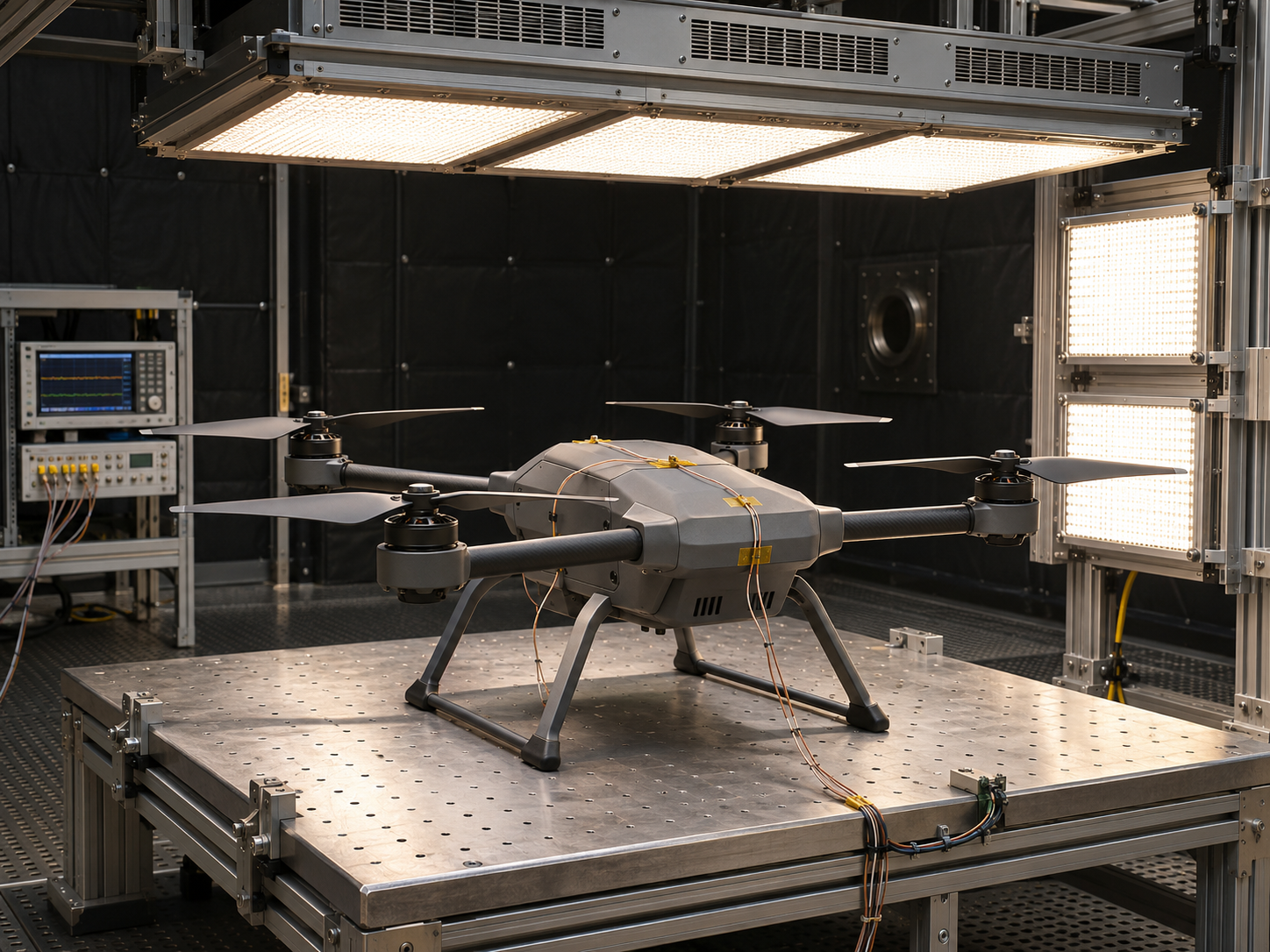
Drones are exposed to different environmental conditions during transport, preparation and use. Direct solar radiation can heat external surfaces and influence the temperatures of the components beneath them. How this load is distributed depends on factors including geometry, materials, surface characteristics and installation conditions.
Defined solar simulation makes it possible to investigate these relationships on the ground under comparable conditions. Individual material samples, housing assemblies or complete specimens can be examined according to the specified investigation objective.
BF Engineering develops irradiation systems for these environmental tests. The design is tailored to specimen dimensions, the relevant irradiation surfaces and the required measurement instrumentation.
Record solar influences on the specimen in a traceable way
An irradiation test investigates how external radiation loading affects the specimen’s temperature conditions. The focus may be on individual external surfaces, housing areas or the relationship between surface and internal temperatures.
For comparative tests, the initial state, orientation and ambient conditions are defined. This allows different configurations to be compared under the same external load. Evaluation criteria are established before the investigation begins.
Typical areas of investigation:
- Heating of external surfaces and housings
- Temperature development in selected installation spaces
- Comparison of different housing and surface configurations
- Influence of different irradiation directions
- Heating and cooling behaviour during defined test phases
Adapt the irradiation arrangement to the geometry
Unmanned aerial vehicles can vary considerably in shape and dimensions. Irradiation is therefore tailored to the surfaces being investigated. Curved surfaces, protruding components and possible shading are taken into account.
Depending on the test objective, constant exposure or specified load profiles over time may be used. Spectrum, irradiance and spatial distribution are defined together so that the applied load suits the investigation.
Key design parameters:
- Specimen dimensions and contour
- Position of the relevant irradiation surfaces
- Radiation spectrum and irradiance
- Irradiation direction and distance from the radiation source
- Exposure duration and load profile over time
Compare surfaces and material composites
Housings, covers and panels can consist of different materials and layer structures. The material, coating and processing are documented for the investigation. For composite components, the construction of the sample also forms part of its description.
Material comparisons can begin with small samples and subsequently be supplemented by investigations of representative assemblies. The extent to which findings can be transferred depends on how well the sample construction and boundary conditions represent the intended installation.
Possible test specimens:
- Plastic housings and covers
- Fibre-reinforced material samples
- Painted and coated external surfaces
- Seals and flexible connecting elements
- Representative housing and material composites
Document external loading and temperature response together
Measurement planning combines verification of the irradiation with temperature measurements on the specimen. Reference positions are established so that external conditions can be checked during recurring tests.
Additional measurement points show temperature development at selected surfaces and inside the specimen. Sensor mounting and cable routing are considered to minimise their influence on irradiation and thermal conditions.
Important measurement and documentation parameters:
- Irradiance at defined reference positions
- Surface temperatures in selected areas
- Temperatures in relevant housing interiors
- Ambient conditions and initial state
- Time correlation of irradiation and temperature profiles
Adapt the experimental setup to the specimen and laboratory environment
The irradiation system is coordinated with specimen mounting, sensors and the existing test environment. Defined positioning and sufficient access for instrumentation are important for recurring investigations.
BF Engineering plans irradiation equipment to suit the agreed test conditions. Interfaces with climate control, data acquisition and the higher-level control system are defined for each project.
Relevant integration considerations:
- Specimen mounting and repeatable positioning
- Clearances for sensors and cable routing
- Electrical supply and additional heat release
- Interfaces with climate control and data acquisition
- Accessibility for specimen changes and maintenance
Any questions?
We're happy to help.
BF is a forward-looking company that specializes in the development, manufacture, and optimization of high-precision systems and specialized irradiation equipment for test benches.

Your contact person
Danelis Diaz
Management Backoffice

Never miss a thing
BF is a forward-looking company that specializes in the development, manufacture, and optimization of high-precision lighting systems and specialized illumination systems for test benches.