Plastics
Irradiation Testing for Plastics
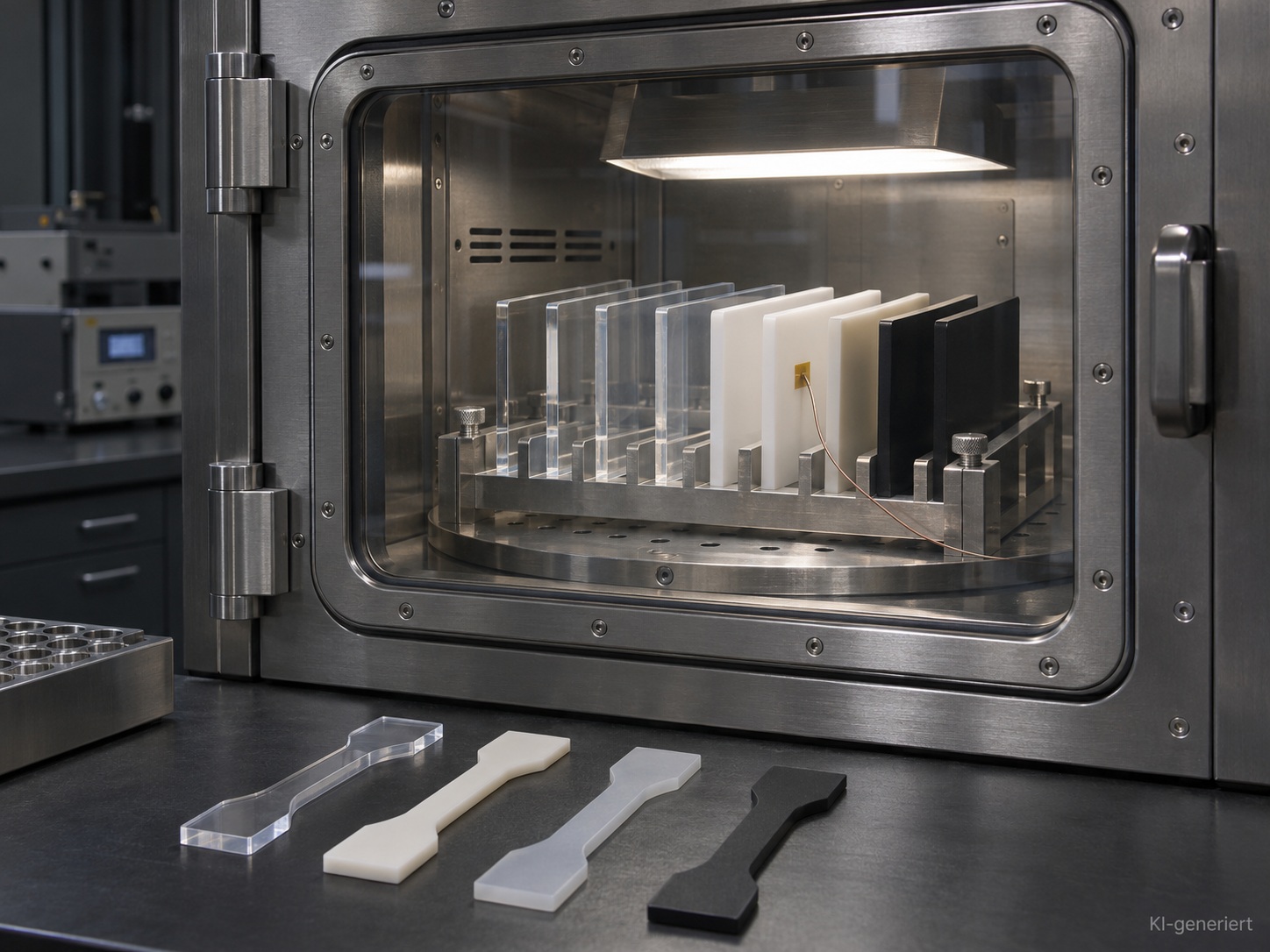
Plastics are used in a wide range of applications – as housings, transparent covers, films, seals or decorative surfaces. The properties they need to retain over time depend on their function and the respective operating conditions.
Defined irradiation tests make it possible to investigate different materials, formulations and component designs under comparable conditions. The radiation source and load profile are selected according to whether the investigation concerns, for example, outdoor use, an application behind glazing or targeted UV exposure. The ISO 4892 series provides a procedural framework for exposing plastics to laboratory light sources.
BF Engineering develops irradiation equipment for these test setups. The radiation spectrum, test area and system configuration are tailored to the material investigation and the intended test conditions.
Compare material variants and component designs
Plastics testing can begin during the selection of a suitable formulation. Small specimens facilitate comparisons between different variants, while investigations of finished components additionally take account of their geometry and processing.
Before exposure begins, the properties to be retained and the changes to be evaluated are defined. Depending on the application, the focus may be on appearance, mechanical properties or component function. Reference samples and documented initial measurements provide the basis for subsequent comparison.
Typical areas of investigation:
- Comparison of different plastic formulations and material batches
- Investigation of pigmentation and stabilisation variants
- Evaluation of transparent and coloured plastic surfaces
- Comparison of different processing variants and component designs
- Preparation of specimens for subsequent functional or material tests
Tailor light exposure to the intended application
Targeted UV exposure and broader-spectrum solar simulation represent different loads. The appropriate option depends on the test objective and the agreed procedure. Where relevant, filtering through glass or other covers is also considered.
Alongside the spectrum, irradiance, exposure duration and spatial distribution are defined. For comparable results, the radiation actually reaching the samples must remain traceable. Changes in sample position or luminaire distance are therefore documented.
Key design parameters:
- Relevant wavelength ranges and spectral distribution
- Irradiance at the sample plane
- Size and uniformity of the usable test area
- Radiant exposure and exposure profile over time
- Filtering through glazing or materials positioned in the optical path
Consider temperature, humidity and specimen mounting together
Irradiation is planned together with the other boundary conditions. The actual sample temperature is particularly important, as it can differ from the air temperature. Different colours, material thicknesses and mounting arrangements can lead to different thermal conditions.
If humidity, wetting or additional loading phases form part of the test programme, these are defined within a coordinated sequence. For comparative tests, sample preparation, conditioning and storage between test steps must also remain traceable.
Relevant boundary conditions:
- Specimen temperature and ambient temperature
- Humidity and wetting conditions, where applicable
- Material thickness, specimen geometry and irradiated side
- Mounting and heat transfer through the specimen holder
- Conditioning, interruptions and intermediate storage
Assess changes according to the material’s function
Evaluation is based on the requirements placed on the plastic material. Optical properties may be decisive for a transparent cover, while mechanical or functional characteristics may be the focus for a component subjected to loads.
Measurement methods and evaluation criteria are established in advance and applied after defined exposure stages. Transferring accelerated laboratory results to specific service periods requires validation appropriate to the material and application; test duration alone does not provide a universal conversion factor.
Possible evaluation parameters:
- Colour change, yellowing and gloss
- Transmittance and haze of transparent samples
- Cracks and changes in surface structure
- Mechanical properties determined using agreed test methods
- Function and dimensional stability of selected components
Design irradiation equipment to suit the specimen programme
Whether testing small sample series or larger plastic components, the setup must suit the intended formats and laboratory workflow. Specimen changes, sensor positions and verification measurements are considered during planning.
BF Engineering tailors the irradiation system to the required test area and agreed loading conditions. Interfaces with climate control, temperature monitoring and data acquisition are defined for each project.
Relevant integration considerations:
- Dimensions and number of samples tested simultaneously
- Suitable holders for sheets, films and three-dimensional components
- Electrical supply and heat removal
- Monitoring of irradiation and temperature conditions
- Accessibility for specimen changes, cleaning and maintenance
Any questions?
We're happy to help.
BF is a forward-looking company that specializes in the development, manufacture, and optimization of high-precision systems and specialized irradiation equipment for test benches.

Your contact person
Danelis Diaz
Management Backoffice

Never miss a thing
BF is a forward-looking company that specializes in the development, manufacture, and optimization of high-precision lighting systems and specialized illumination systems for test benches.