UV Irradiation
UV Irradiation for Research and Laboratories
Ultraviolet radiation can cause changes in materials and surfaces. For research, it is essential to understand the conditions under which these changes occur and how they relate to the radiation used.
Defined UV experiments make it possible to investigate selected influencing factors systematically. Wavelength range, irradiance, exposure duration and temperature are established to suit the research question. Differences between material variants or experimental configurations can therefore be examined under traceable conditions.
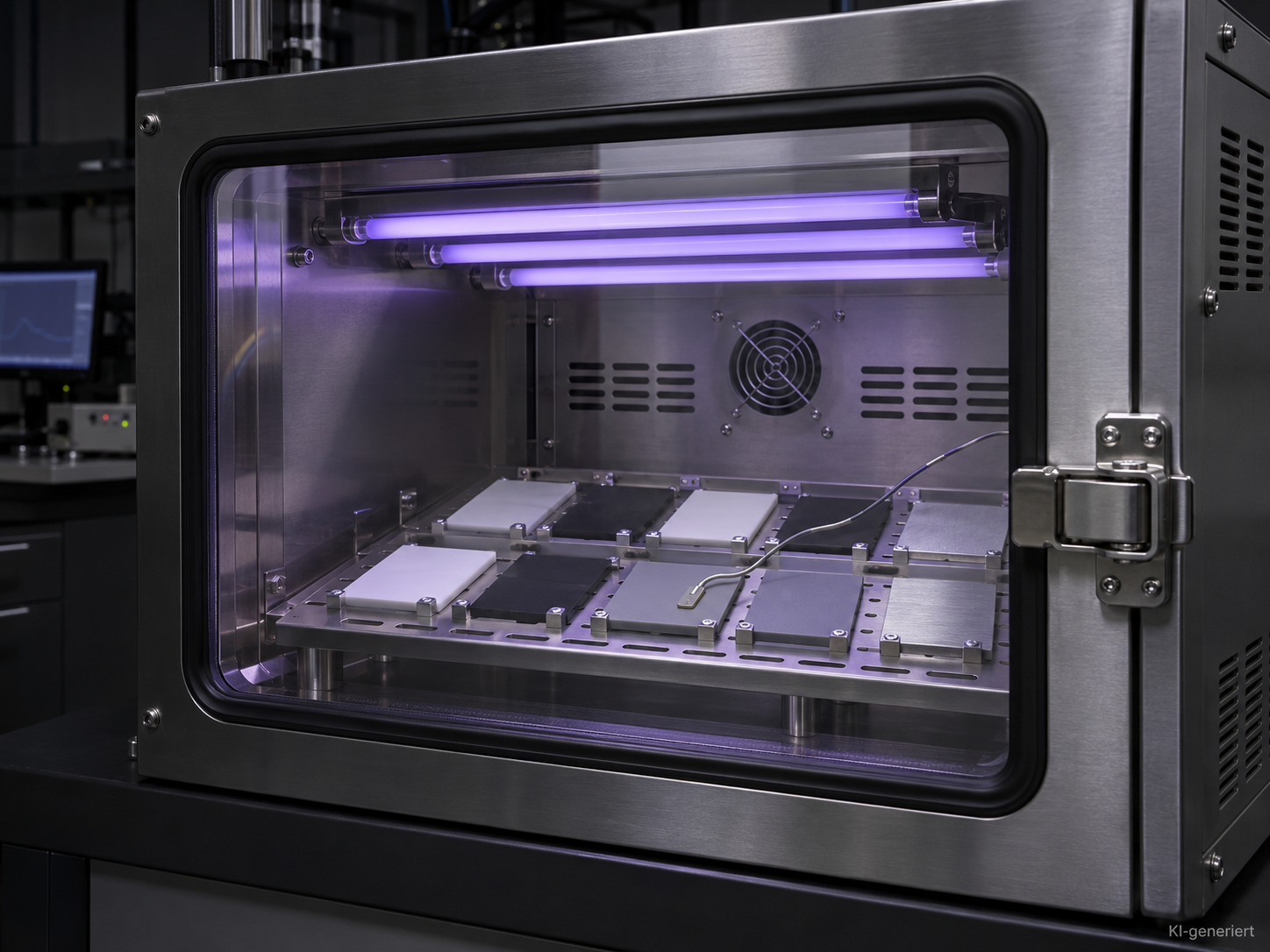
BF Engineering develops UV irradiation systems for different test requirements. The radiation source, test area and system configuration are tailored to the respective application.
Systematically distinguish between UV-related influences
UV experiments can be used to identify changes or investigate differences between samples. For example, material composition can be varied while irradiation and temperature remain constant.
During experimental planning, the property to be investigated and the required comparison conditions are established. Unexposed reference samples or supplementary temperature tests can help interpret the results and distinguish between different influences.
Typical research tasks:
- Comparison of polymers and coatings under UV exposure
- Investigation of colour and surface changes
- Analysis of the effects of different exposure conditions
- Evaluation of protective coatings and UV-absorbing materials
- Preliminary investigations for subsequent ageing and component tests
Define the wavelength range and radiation source
The term UV covers a broad wavelength range. For a meaningful experiment, it is therefore necessary to specify which part of this range is relevant and which spectral characteristics the source should provide.
Investigations into solar UV loading have different requirements from targeted exposure at selected wavelengths. Sample covers, filters and optical windows must also be considered, as they can modify the radiation before it reaches the sample.
Key spectral design parameters:
- Required UV wavelength range
- Spectral distribution of the intended radiation source
- Requirements for filters and optical covers
- Spectral transmittance of materials positioned in the optical path
- Suitable sensors for the radiation used
Plan radiant exposure, temperature and sample arrangement together
The load applied to a sample depends on irradiance and its duration. For comparative experiments, exposure duration, radiant exposure and spatial distribution are therefore documented. Recording operating time alone is insufficient if the actual irradiance differs between experiments.
Sample temperature is also considered. Mounting, airflow and radiation absorption can influence the thermal conditions. Whether continuous exposure or a sequence of irradiation and rest phases is appropriate depends on the research objective.
Relevant exposure conditions:
- Irradiance at the sample plane
- Radiant exposure and duration of individual exposure phases
- Specimen temperature and ambient conditions
- Sample position, irradiated side and orientation
- Interruptions and storage between experimental phases
Link changes to the exposure conditions
The investigation begins by recording the initial condition. Depending on the research question, optical measurements, functional tests or further analyses may be planned. The same procedures are repeated after defined exposure stages.
Clear sample identification links the results to the corresponding exposure data. If several variants are investigated simultaneously, their positions within the test area must also remain traceable. This allows differences to be examined systematically during evaluation.
Possible evaluation and documentation parameters:
- Initial condition and defined intermediate states
- Colour, transmittance or other relevant optical properties
- Surface appearance and documented changes
- Mechanical or functional properties according to the research question
- Linking sample position, exposure and analytical results
Coordinate UV equipment with laboratory operations
Integration covers the radiation source, sample mounting and required monitoring. The enclosure and access during sample changes are also planned to suit the application.
BF Engineering tailors the irradiation equipment to the available space and intended experimental sequence. Interfaces with temperature control, data acquisition or external controls can be incorporated on a project-specific basis. Maintenance and regular checks of irradiation conditions are also included in planning.
Relevant integration considerations:
- Size and arrangement of the usable test area
- Sample handling and access to the test space
- Enclosure and application-specific protective functions
- Supply requirements, heat removal and control interfaces
- Accessibility for sensor checks, cleaning and maintenance
Any questions?
We're happy to help.
BF is a forward-looking company that specializes in the development, manufacture, and optimization of high-precision systems and specialized irradiation equipment for test benches.

Your contact person
Danelis Diaz
Management Backoffice

Never miss a thing
BF is a forward-looking company that specializes in the development, manufacture, and optimization of high-precision lighting systems and specialized illumination systems for test benches.