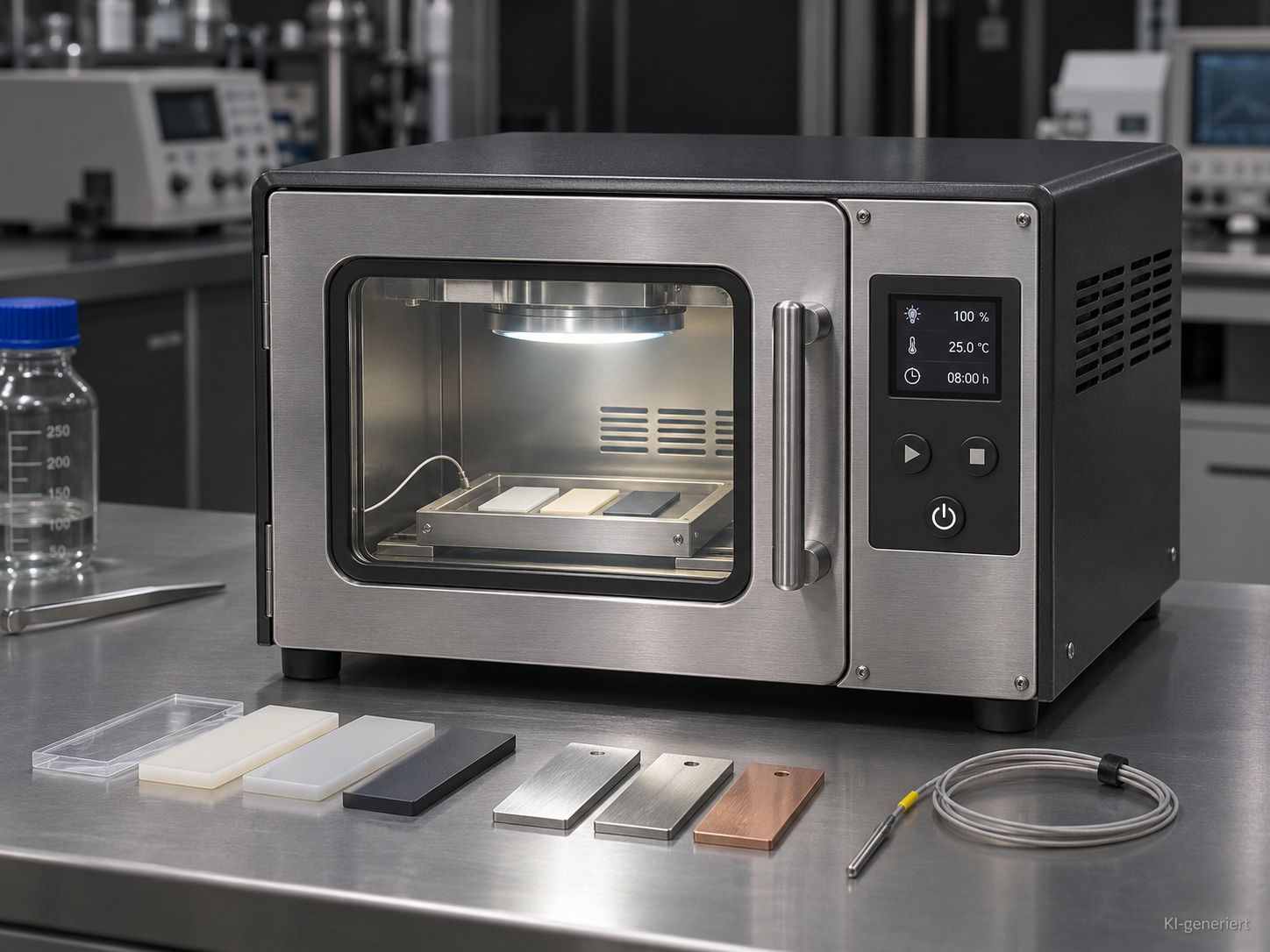
Benchtop Devices
Compact Irradiation Devices for Research and Laboratories
Not every research task requires a large-area test system. Investigations often focus on individual material samples, small components or initial functional prototypes. A compact test setup makes it possible to carry out these investigations directly at the laboratory workstation and compare different variants under comparable conditions.
Benchtop devices combine a manageable test area with easy access for specimen changes, instrumentation and inspection. The key is to coordinate the radiation source, specimen mounting and measurement task. Depending on the investigation, solar-like irradiation, targeted UV exposure or thermal radiation loading may be required.
BF Engineering develops compact irradiation solutions for research, development and material testing. Dimensions, equipment and controls are tailored to the respective application.
Investigate small specimens under defined, comparable conditions
Compact irradiation devices are suitable for investigations in which a limited area is to be exposed under defined conditions. These include material comparisons, preliminary tests and investigations of individual components before larger assemblies are tested.
Particularly during early development stages, small samples can help keep testing effort manageable. Different material variants can be investigated using the same arrangement. The extent to which the findings can subsequently be transferred to larger components depends on geometry, installation conditions and the relevant interactions.
Typical applications:
- Comparison of small material and surface samples
- Investigation of coatings, films and layered composites
- Irradiation of individual sensors and electronic components
- Preliminary tests for subsequent component or system testing
- Experimental investigations of functional models and prototypes
Select the radiation source to suit the investigation
Design begins by identifying the effect to be investigated. Thermal loading has different requirements from UV-induced material changes or investigations under solar-like radiation.
Alongside spectral distribution, the required irradiance and usable test area are defined. Distance and orientation also influence the load on the specimen. Adjustment options are therefore planned so that changes can be documented and settings restored when required.
Key design parameters:
- Radiation spectrum suited to the investigation objective
- Irradiance at the intended test plane
- Size and uniformity of the usable irradiation area
- Distance and orientation between the radiation source and specimen
- Exposure duration and required load profile over time
Plan specimen mounting and accessibility together
A compact test setup should position the specimen securely while providing sufficient access for sensors and specimen changes. The mounting arrangement is tailored to the specimen’s shape, size and sensitivity.
The mounting arrangement itself can influence the investigation. Shading, heat dissipation through the holder or mechanical stresses can affect the result. For comparative tests, specimen position, mounting and irradiation direction are therefore clearly defined.
Relevant test setup considerations:
- Dimensions and weight of the intended specimens
- Suitable holders for different sample formats
- Defined positioning and orientation
- Access for sensors, cables and specimen changes
- Consideration of shading and heat transfer through the holder
Record the applied load and specimen response together
The device settings initially describe system operation. To evaluate the test, it is also important to establish the load actually reaching the sample and how the specimen responds.
Depending on the investigation, radiation measurements, temperature measurements or other measurement methods can be used. Measurement positions and reference conditions are established in advance. This allows results from different samples or test days to be compared in a traceable way.
Important measurement and documentation parameters:
- Irradiance at defined reference positions
- Specimen and ambient temperatures
- Sample distance, orientation and position
- Exposure times and documented interruptions
- Initial condition and results of the subsequent investigation
Adapt the device to the available workstation
A benchtop device must suit the existing laboratory infrastructure. Alongside its footprint, the required clearances, electrical supply and heat release must be considered. Whether an additional enclosure or further measures are needed depends on the radiation source and application.
Daily operation is also considered during planning: specimens should be easily accessible, settings should remain traceable and maintenance should be straightforward. Required interfaces for data acquisition or external control are defined for each project.
Relevant laboratory integration considerations:
- Footprint, device dimensions and accessibility
- Electrical supply and heat removal
- Enclosure and application-specific protective functions
- Operation and external control, where applicable
- Access for cleaning, maintenance and verification measurements
Any questions?
We're happy to help.
BF is a forward-looking company that specializes in the development, manufacture, and optimization of high-precision systems and specialized irradiation equipment for test benches.

Your contact person
Danelis Diaz
Management Backoffice

Never miss a thing
BF is a forward-looking company that specializes in the development, manufacture, and optimization of high-precision lighting systems and specialized illumination systems for test benches.