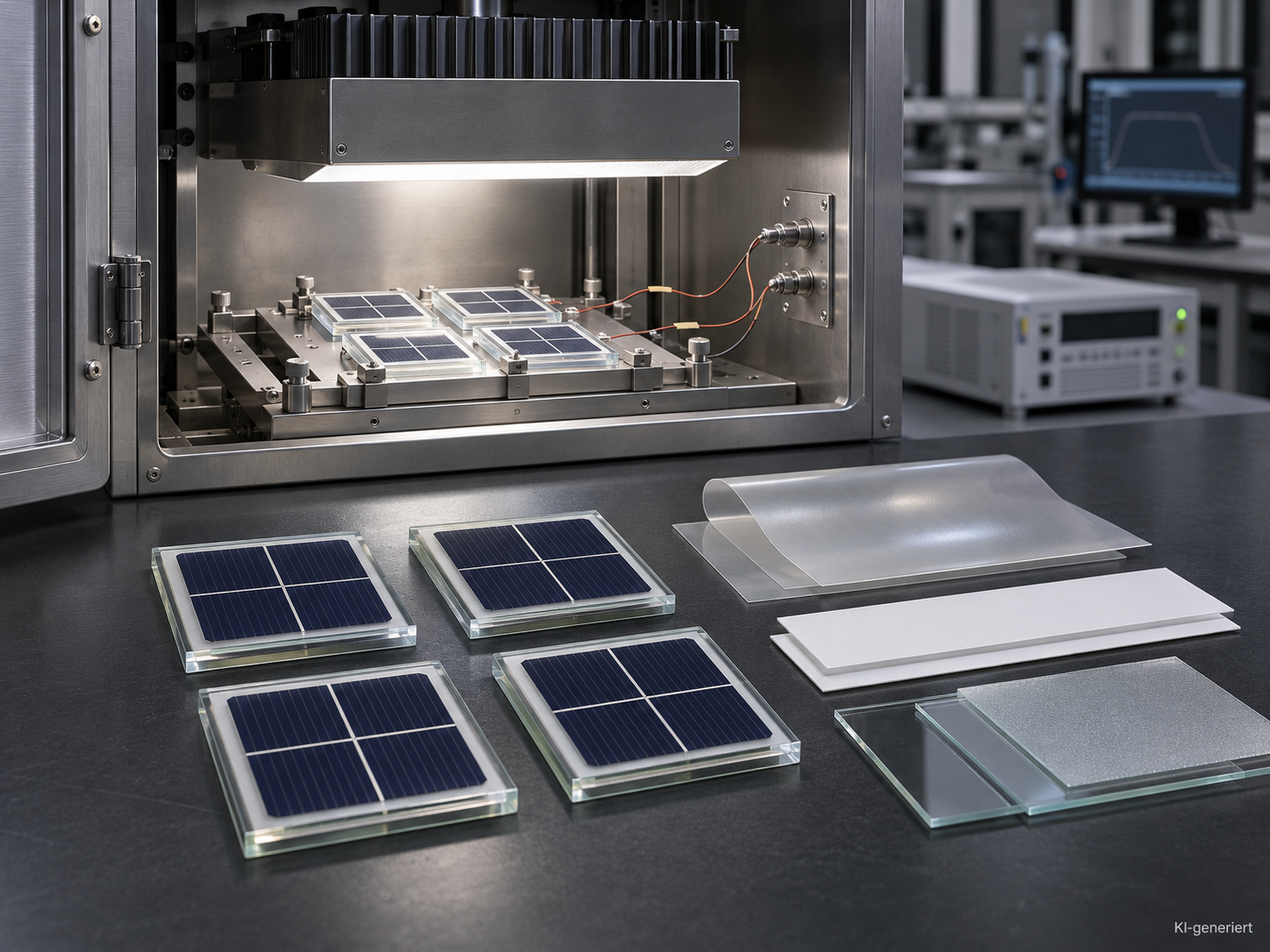
Material Testing
Irradiation Testing for Photovoltaic Materials
The reliability of a photovoltaic module also depends on the materials used and how they interact. Encapsulants, backsheets, coatings, adhesives and sealants perform different functions and must retain their relevant properties under the intended operating conditions.
Radiation, temperature and humidity can change materials and interfaces. Irradiation tests make it possible to investigate selected influences systematically. Both individual samples and representative layered composites can be examined. Investigations into PV backsheets, for example, demonstrate why material changes and their relationship to the module construction should be evaluated together.
BF Engineering develops irradiation equipment for these material tests. The design is based on the specimen, the relevant wavelength ranges and the intended investigation and evaluation procedures.
From individual materials to representative layered composites
Material testing can begin during the selection of suitable materials. Small samples make it easier to compare different formulations or coatings under identical conditions. The investigation can focus on selected material properties.
For questions concerning the subsequent module construction, additional tests on layered composites may be useful. The behaviour of an individual material cannot automatically be transferred to its installed state. Adjacent layers, processing and installation position influence the actual load experienced by a component.
Typical test specimens:
- Encapsulants and transparent polymer samples
- Backsheets and multilayer film composites
- Glass with different coatings
- Adhesives, sealants and edge seals
- Small test laminates and representative material composites
Select irradiation to suit the material investigation
The load profile is derived from the investigation objective. Targeted UV exposure may be appropriate for one question, while another may require broader-spectrum irradiation. Radiation spectrum, intensity and temperature must therefore be defined together.
The combination or sequence of different loads can also be relevant. If irradiation is to be combined with further climatic or mechanical tests, for example, the transitions between the test steps are documented. An accelerated laboratory test can only be translated into a statement about service life on a suitable, validated basis.
Important elements of the load profile:
- Relevant wavelength ranges and radiation spectrum
- Irradiance, exposure duration and radiant exposure
- Temperature conditions during exposure
- Combination with humidity or other loads, where applicable
- Sequence of test steps and conditions between exposures
Position specimens and apply loads under comparable conditions
A suitable test setup takes account of specimen shape, size and sensitivity. The mounting arrangement should provide a defined position while minimising its influence on the surface under investigation. Shading, additional heat dissipation and stresses caused by mounting are considered during planning.
For material composites, the irradiated side must be specified, along with the layers located between the radiation source and the material being investigated. Reference and comparison samples can help distinguish changes occurring during exposure from other influences.
Relevant test setup considerations:
- Specimen dimensions and available irradiation area
- Mounting and orientation relative to the radiation source
- Irradiated side and arrangement of intervening layers
- Positioning of temperature and radiation sensors
- Identification and assignment of reference and comparison samples
Align evaluation with the material’s function
Which changes are significant depends on the material’s role within the module. Optical properties may be the focus for a transparent layer, whereas an adhesive may be assessed primarily on the bond between the surfaces involved.
Suitable analytical methods and evaluation criteria are therefore selected before exposure begins. Additional investigations can include optical measurements, microscopy or mechanical tests. Such methods are also used in PV module and component characterisation.
Possible evaluation parameters:
- Colour changes, yellowing and surface appearance
- Transmittance, reflectance or other relevant optical properties
- Cracking and changes within the layered composite
- Adhesion strength and mechanical properties of suitable samples
- Electrical or insulating properties according to the material’s function
Combine irradiation and material analysis into a test sequence
A material test station must support both exposure and subsequent specimen handling. Multiple variants, reference samples and intermediate measurements often need to be organised. Clear identification and documented specimen positions facilitate subsequent evaluation.
BF Engineering tailors the irradiation equipment to the required specimen formats and test conditions. Interfaces with climate control, sensors and data acquisition are planned to suit the existing laboratory infrastructure.
Relevant integration considerations:
- Number and format of the samples being investigated
- Specimen changes and access for intermediate measurements
- Temperature control and connection to climatic equipment, where applicable
- Recording of irradiation conditions and operating times
- Maintenance, cleaning and verification of the usable test area
Any questions?
We're happy to help.
BF is a forward-looking company that specializes in the development, manufacture, and optimization of high-precision systems and specialized irradiation equipment for test benches.

Your contact person
Danelis Diaz
Management Backoffice

Never miss a thing
BF is a forward-looking company that specializes in the development, manufacture, and optimization of high-precision lighting systems and specialized illumination systems for test benches.