UV Preconditioning
UV Preconditioning for Photovoltaic Modules and Components
Photovoltaic modules are continuously exposed to solar radiation during operation. The ultraviolet portion can cause changes in polymeric materials, affecting the properties of encapsulants, backsheets and other components. The changes that occur depend on factors including material composition, radiation spectrum, temperature and accumulated radiant exposure.
Defined UV preconditioning allows modules and material samples to be conditioned systematically and subsequently examined. It can form part of a specified test sequence or be used for comparative development tests. The exposure conditions must suit the investigation and be documented clearly.
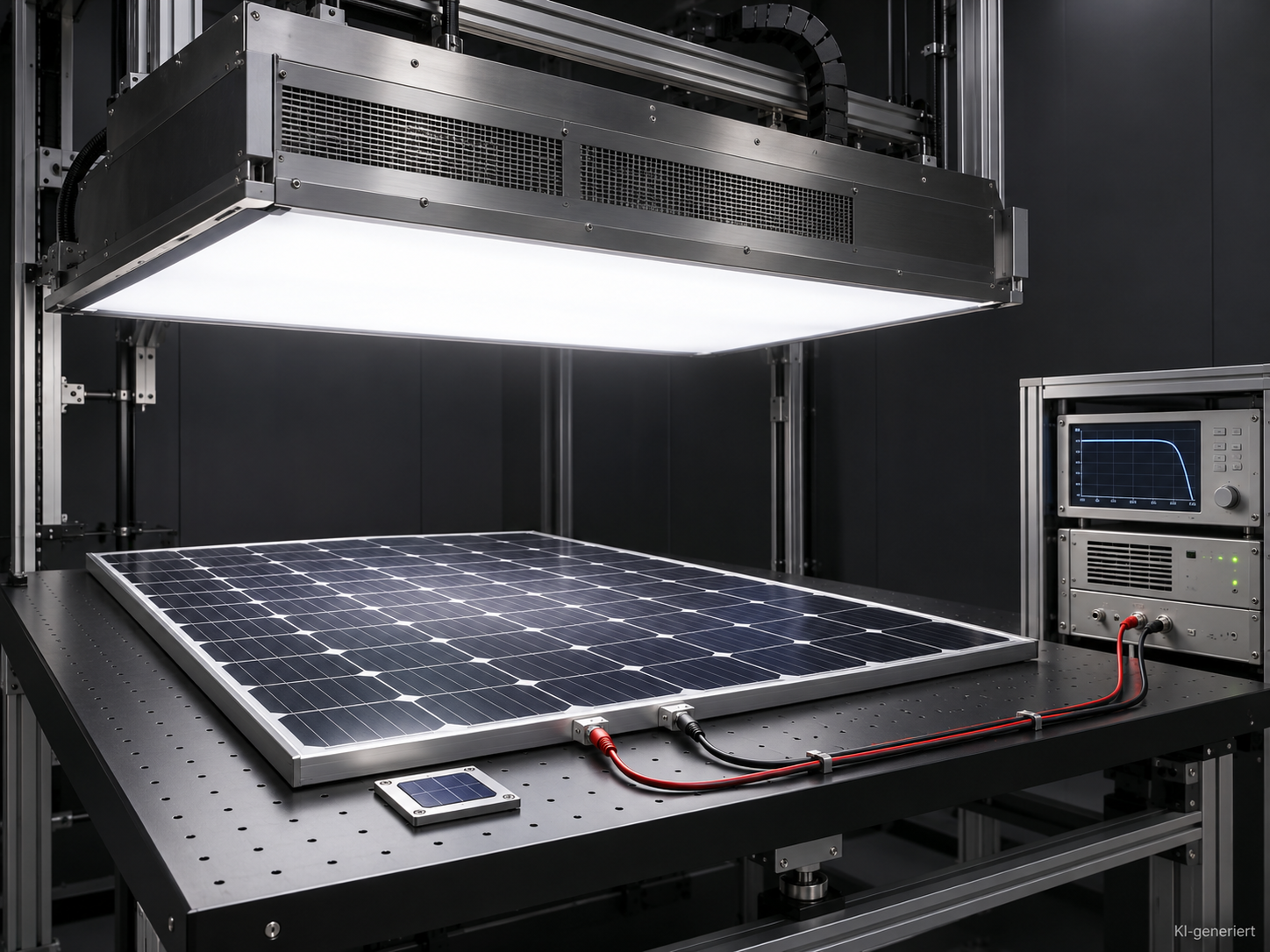
BF Engineering develops UV irradiation systems for testing photovoltaic modules and PV components. The design is tailored to specimen size, spectral requirements and the intended operating conditions.
Precondition materials and module constructions systematically
During UV preconditioning, a test specimen is subjected to a defined UV load. Subsequent investigations show whether and to what extent selected properties have changed. Depending on the test programme, complete modules, small test modules or individual material samples can be examined.
For development comparisons, different material formulations or layer constructions can be assessed against one another. If preconditioning forms part of a multi-stage test sequence, the order of the loads and the conditions between individual test steps must also be defined.
Typical areas of investigation:
- Comparison of different encapsulants and backsheets
- Preconditioning of modules for subsequent tests
- Investigation of selected materials and layer constructions
- Comparison of material batches and development variants
- Documentation of changes after defined exposure stages
Coordinate spectrum, irradiance and radiant exposure
In UV testing, spectral distribution is important alongside irradiance. Two radiation sources can have different effects on a material despite having the same total power if their contributions within the relevant wavelength ranges differ.
Radiant exposure is determined by the irradiance integrated over time. Intensity, exposure duration and spatial distribution are therefore considered together. Higher irradiance does not automatically allow the test duration to be shortened arbitrarily: whether comparable material responses occur must be evaluated for the respective procedure.
Key design parameters:
- Relevant UV wavelength ranges and spectral distribution
- Irradiance at the specimen plane
- Target radiant exposure and exposure duration
- Spatial uniformity within the usable test area
- Monitoring and documentation of radiation during operation
Fully describe the conditions applied to the specimen
UV exposure is planned together with the thermal conditions. A distinction must be made between air temperature and the actual specimen temperature. An irradiated material can heat up relative to its surroundings and therefore age under conditions different from those initially assumed.
Specimen mounting, the irradiated side and, where applicable, humidity conditions also form part of the test concept. For standards-based tasks, the parameters are taken from the specifically agreed procedure. Development tests can use individually defined load profiles, provided their objectives and boundary conditions are clearly described.
Relevant boundary conditions:
- Specimen temperature and temperature sensor positions
- Ambient temperature and, where applicable, humidity
- Irradiated side and specimen orientation
- Distance from the radiation source and type of specimen mounting
- Exposure phases, interruptions and intermediate storage
Compare changes before and after exposure
Evaluation begins with a documented initial examination. The characteristics recorded depend on the test objective. Measurements before and after exposure should be performed under comparable conditions so that changes can be identified reliably.
Depending on the investigation, optical, electrical or mechanical examinations may follow. The irradiation system provides the defined load; the analytical methods and evaluation criteria are selected within the overall test concept.
Possible evaluation parameters:
- Visible changes and standardised photographic documentation
- Colour, yellowing or optical transmittance
- Electrical characteristics of complete modules
- Adhesion behaviour and mechanical properties of suitable samples
- Comparison of results after different exposure stages
Design UV equipment to suit laboratory workflows
Whether for a compact specimen test setup or large-area module testing, the irradiation equipment must suit the available space, specimen handling and planned throughput. Recurring verification measurements and access to bulbs and sensors are also considered during planning.
BF Engineering tailors the UV equipment to the required test area and agreed operating conditions. Interfaces with temperature control, data acquisition and the higher-level control system are defined for each project.
Relevant integration considerations:
- Dimensions and number of specimens irradiated simultaneously
- Specimen mounting and accessibility during loading and unloading
- Electrical supply and removal of additional heat
- Monitoring, protective functions and documentation
- Maintenance access and regular verification measurements
Any questions?
We're happy to help.
BF is a forward-looking company that specializes in the development, manufacture, and optimization of high-precision systems and specialized irradiation equipment for test benches.

Your contact person
Danelis Diaz
Management Backoffice

Never miss a thing
BF is a forward-looking company that specializes in the development, manufacture, and optimization of high-precision lighting systems and specialized illumination systems for test benches.